Popular Posts

Showing posts with label Ayn Rand. Show all posts

Tuesday, July 8, 2014

REVIEW Snowpiercer: A Reading Through Ayn Rand's Atlas Shrugged

In reading this review from Unemployed Negativity more resonances emerged. I love his reading BTW. I am reading the film Snowpiercer through Ayn Rand's Atlas Shrugged, a sort of different reading.
In the early 1960's I attended Objectivist Lectures in Philadelphia given by Barbara Branden. (1960-1962) and sometimes Rand herself came to the Q and A time after the lecture. I never asked one question in two years. I didn't because I had read her fiction and newly published non-fiction (For the New Intellectual and The Objectivist Newsletter) and any question that was asked I already knew what my answer would be and waited to see what Barbara Branden, Nathaniel Branden, Leonard Peikoff, Alan Greenspan, et al and even Ayn Rand herself would reply.The questions were most often stupid and were posed because, well, IDK why........maybe just so they could stand up and ask her a question?
So while Barbara and Nathaniel were cool and poised, Rand would begin to show irritation, frustration (me too) and would sometimes get angry or at least emotional.

Ayn Rand testifying at HUAC-House UnAmerican Activities Committee
In Mason's speech to the people in the "tail" she perseverates by repeating
So be it.
It is so.
over and over again
When Rand was stressed at a Q&A session being the flyswatter that Nietzsche said he wasn't going to be:
("I am not a flyswatter!")
Rand would say with finality:
A Is A!
Inversion of the quote is Nietzschean trope and Rand started with Nietzsche when she was 16 memorizing him

So when Tilda Swinton gives her over the top speech as Mason in Snowpiercer, my immediate association was not Thatcher but Rand in all her outrageousness. Her hair, her facial expressions, all exaggerated of course. Much like the teacher in the classroom car is all Reese Witherspoon in her 1999 movie Election, so much so that I thought young Reese was in the movie for a second.
And less you think these train cars are too too.....
The New Japan Cruise Train
WOW
Another car on Japanese train
Here is a clip of Tilda Swinton as Mason. A man's arm is being attached to a "sleeve" to plug into its gasket in the train to have the arm held out to the way below arctic freezing temperature outside to demonstrate to the "tail" section the danger in revolting and stepping outside the safety of the train. Mason gives her speech and she is quite mad and wonderful.
http://youtu.be/_47ph6EvQPU

Tilda Swinton as Mason in Snowpiercer.

The Sacred Motor is the "sacred" motor Dagny finds at the defunct Twentieth Century Motor Company, where Galt was working and designed it. It is an engine of the future and it is in need of serious repair which Dagny gives to - I forget - to fix. Dagny has plans to put this engine into her locomotives of Taggert Transcontinental. Dagny's engine will ride the rails made of Reardon Metal a metaphorical image irresistible to someone who thinks Lacanian. The engine in Atlas is patterned after Nicola Tesla's engine built for Westinghouse when he was inspiring Edison who stole all his ideas. It was an engine that had no fuel needs, just evidently air, that car accelerated in a few seconds. It was scrapped, its existence hidden, a secret. After all Standard Oil of New Jersey was a powerful corporation at that time. An eternal engine like that would not have been welcomed by the players of the game. Anyway it is gone and we just imagine and guess about it and some try to reinvent it in their garages.

So here it is in all its magic glory in Snowpiercer. A train that circles the earth once each year, like a sort of ground satellite. The Eternal Sacred Engine is everlasting, irreversible, just like Capitalism. It continually goes. The social structure inside the train is confinement of classes. The beggars of the earth are in the "tail" - nice symbolism here - and the Sacred Engine is at the front with its designer who is now getting old. He is wearing out.

The point that Unemployed Negativity brings out is Zizekian thinking. So I urge you to read it. The humans inside the train are confined within the Foucauldian Grid of power/knowledge. Resistance is possible and revolutions do happen but do not overthrow the system. The system devours them like Pac-Man (Marcuse) and is strengthened by them. (Vija Kinski will tell Eric Packer the same thing in DeLillo's Cosmopolis.) Baudrillard will challenge Foucault in his book
telling Foucault to go to the edge of the abyss and continue the pressure until it all implodes into the chasm. Until it commits suicide. 

And this is Snowpiercer, as well as Atlas Shrugged

What Unemployed Negativity says is that no one inside the train can imagine life outside the train in the ice-age out there. And we in our world now cannot imagine our way out of it. Only one person on the train knows about snow. A nice wave to that wonderful novel
Smilla's Sense of Snow
Just in case you never knew this book it is a marvel
The Asian drug addict Kang-ho Song in a wonderful performance has observed that the snow is melting. That they can exist outside the train. 

He wants to create an explosion


that will avalanche the mountains of snow. Curtis now the Curtis Revolution of 18 (years 

they have been on the train) gives in on continuation when Trainbaby shows him what is 

under a hatchlock. He sees what he will have to continue doing and he cannot.

He agrees to the explosion, gives her the match, and these last few 

huddle together waiting for the detonation.

Then when Trainbaby 


Curtis and Trainbaby born on the train 17 years ago

who knows nothing about what is in the world or how people lived, she is the

tabula rasa, she and the rescued child dress warmly and go outside. Her footsteps

 sink but she does not. Nothing is there but mountains of snow until she sees a white 

movement far off.

 It turns and we see a polar bear. Is the bear out hunting for food? She has no weapons,

 no place to go for shelter as the train was burning inside. She and the child are the only 

survivors. That wonderful moment as she pushes her hood off her head bared to the air.


A helpless human. 

A return to the beginning. Eternal Return - Nietzsche

The last frame is the polar bear looking at us.
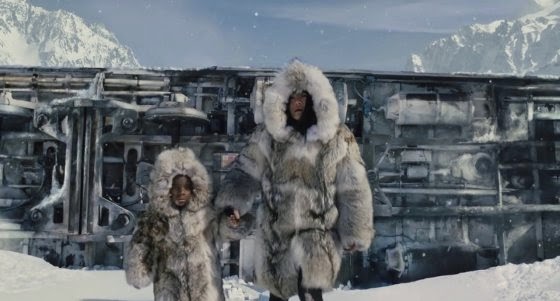


This is a gorgeous film made by a visionary auteur director Bong Joon-ho


Chris Evans
Tilda Swinton
Jamie Bell
Ed Harris
John Hurt
Alison Pill
Octavia Spencer


Arturo the Polar Bear in Arizona Zoo. - Help Rescue him

Wednesday, May 7, 2014

Review DIVERGENT: Deconstruction of the Script by Vanessa Taylor

Vanessa Taylor

Evan Daugherty
Disclosure: I was sent a bootlegged copy of Snow White and the Huntsman of Daugherty's sold script and it is so awful I was embarrassed for him to have written it while I was reading it. Even with Hossein Amini's doctoring of it, it was still filled with cringe worthy lines kept from the original. So I attribute the beauty of the writing in the Divergent script to Vanessa Taylor. It is intelligent, brilliantly so. 

As Foucault says, "When the writing is elegant it means that what is said is important."


Universal and Rupert fired him. (A blessing.)Five writers worked on Snow White. Rupert saved that film, made it beautiful. So much for Daugherty.

Aphoristic:Nietzsche's writing is almost completely aphoristic. It is musical and slips through your critical consciousness. The reader has no defenses. Nietzsche the great rhetorician of his time knew this full well. Ayn Rand, his disciple all her life followed his advice. Stephenie Meyer did, aware or not.


Your writing must be even more so than what you are writing about. - Nietzsche

Divergent is pared down, minimalist, no fluff. So is Dauntless.

Beatrice feels everyone is afraid to volunteer to be First Jumper. So she says, "Me."
And this is the pairing of brave/selflessness that Four will say to her later. She chooses here to be selfless which is also to be brave. And she chooses instead of holding back as she has done so far being last down the stairs, up the ladder, on the train, and jumping across the abyss. Now she will be first.

All of this is conveyed in the images and the one word "ME."

Here's Four as we first see and hear him: 


Our first look here at Four reveals his open and rather surprised face. He has witnessed a 

gift from the sky, from the Heavens miraculously appearing in the net. Like a Silkie from 

the deep. Or Dante's Beatrice: a gift from the Heavens, a Blessing.


Four: What,you were pushed?(quietly)

Beatrice: No. (all breathlessly happy)Thank 

you. (as he helps her down)

Four: What's your name?

Beatrice: B......stuttering

Four: Is it a hard one? 

Beatrice: nodding yes embarrassed

Four: You can pick a new one. But make it good. You only get to  pick once.(emphasis on 

choosing with no reversal)

Beatrice: stuttering saying Tris. My name is Tris.

Four: First jumper - Tris! Welcome to Dauntless.

So quick. The contained surprise that the first 

jumper is a girl, from Abnegation, who 

appears elated rather than frightened by her 

ordeal so far. Four is open faced, nice, 

assertive and non-threatening, non-aggressive. 

The ideal  presentation of the Butlerian 

masculine social construction of gender is performed.

Four has a beautiful face, intelligent and sensitive and sexy. But he is matter-of-fact all 

business here, gently and firmly. No provocation, just a short intimate moment.


People say that the first minutes of any encounter encompass the whole relationship in 

miniature. - ALEX by Pierre Lemaitre (p. 339)


There is quite a bit of subtext in this short and vivid scene:

1. He underestimates her sort of by alluding to the fact he thinks she was pushed.

2. He intuits her dissatisfaction with Beatrice and suggests it is possible for her to change 

her name, become a different person, become Other. He offers her a way to change her 

name with the limiting factor that it is a one shot choice with no return.

4. His welcome is warm and accepting. This is unlike Eric's immediate dislike of her (his 

frozen face) when she volunteers to be first.

5. Through Lacan, Tris rhymes with Chris, short for Christina her first friend. 


Here is Four's account of that first meeting with Beatrice/Tris in Allegiant:

When her body first hit the net, all I registered was a gray blur. I pulled her across it 

and her hand was small, but warm, and then she stood before me, short and thin and 

plain and in all ways unremarkable--except that she had jumped first. The Stiff had 

jumped first.

Even I didn't jump first.

Her eyes were so stern, so insistent.

Beautiful. (Allegiant p. 491)
_________________________________________

Here is Tris's account just before she dies.

I choke on a sob as the image of Tobias comes into my mind, of how dark and how still his eyes were, how strong and warm his hand was, when we first stood face to face. (Allegiant p. 475)


____________________________________________

Bataille in his The Eye: Her: Which part of me did you fall in love with first? Him: Your eyes of course.

All this in 9 short sentences and the images. Now that is a screenplay folks. 

Four introduces himself to the group as their instructor and says: My name is Four.

Christina: Like the number four.
Four: Exactly like the number four.
Christina: Were one, two and three taken? 
Four: What is your name?
Christina: Christina.
Four: (stepping closer to her face, half smiling)
Four: Well Christina, the first lesson you will learn from me is to keep your mouth shut,  if you want to survive here. Do you understand?
Christina: (nodding yes) 
Four: Good. (stepping back from her)

I will interject here to make a point Baudrillard makes on seduction and provocation. Christina is provocative not seductive. Tris is seductive.

All this is said firmly, assertively, non-threatening in a way that projects that he means what he says. Four's truth - not his candor - is frightening to Christina, the others and establishes Four's character.The difference between truth and candor (ventilating) is revealed for those who want to make this connection.

The Dauntless training here is immediately demonstrated as serious. We are not going to be your friends. It is not "training lite, decaffeinated training" as Zizek might say. 

Four has been written to be performed as the new masculine. He has established a distance between his students and himself. This intensifies the transference and transgression. And the sexual eroticism.

The trainers have no intention to be buddy buddy friendly with the initiates.And this is 

appropriate in a military paradigm.

In Roth's book his relationship with them is all muddied up. Vanessa Taylor has skimmed off the fluff to reveal the essence. And this is what is contributing to the Desire of the YA female/male viewers.The character Four's Excess is perceived as Desire, reading through Lacan and Zizek. The fantasy always present in Desire evaporates when listening to his interviews. Theo James is not Four. In the case of Twilight and Rob Pattinson it did not vanish but leaked across boundaries of screen and real life.


Neil Burger's direction - in screenplay? - will have Four walk into almost every scene. His is a distinct, purposive, masculine walk that is immediately sexy and seductive rather than provocative.If he is in the scene already his face responds to the context of it.His Inscription of the Body is the new masculine: fit, sexy, sensitive, intelligent, and competent in what he has chosen to do. His flipping with the knives is masculine, the way he stands in the train when he lectures them. All on purpose.

The faces: This is the influence of Passolini on Burger. The use of the face to convey emotion, thinking, hidden feelings, vulnerability, etc. Not the way Francis Lawrence used Rob Pattinson's face as porno in Water For Elephants. This is not to say Four's face is not sexy. It is, but there is more to the image than just beauty. And Burger's use of Tris's face is incredible. That young woman has so many different faces. Her face of repose in Abnegation is completely different from her face in repose in Dauntless. The close close-ups reveal her emotions when she doesn't look pretty or beautiful but very messed up. Shai performs Tris as a girl who grew up never having looked at her face in a mirror. Shai is fearless when looking in the lens of the camera.Rob Pattinson always knows how he looks when he looks in the lens as he was a model. Now he can't unknow it. And then there are those times he doesn't give a shit. 


Primitive cultures felt that mirrors were destructive. One should know their face from the way they respond to people and the way people respond to them. 


Theo James knows and early on in the film - it was shot in sequence - I felt uncomfortableness when the camera closed in on him. Especially when he runs at the head of the initiates and is called over and says, 

"What've you got?" and we are shown the Factionless. It is quick and emphasizes his expressed masculinity - the way Four runs -  as well as showing us the Factionless in a group that appears somewhat menacing. Is it because they were once initiates who were dropped into Factionless status? The question hovers silently.

I am not finished deconstructing this script but this will do for now.

Thursday, February 14, 2013

Review: KILLING THEM SOFTLY

KILLING THEM SOFTLY lasted just one week at the discount theatre in Brad Pitt's home town Springfield, Missouri. This is absolute proof of its exceptional excellence.

This is a perfect film. It is relentless without a shred of seductive illusion, illusionary seduction in it. There are no throwaway laugh lines either. It is a completely post modern look at our world. Ayn Rand would have loved it. Pitt's fingerprints are all over it, and he is so fine in it, but then so is everyone else.  The violence is viewed in slow motion, a choreographed dance of shattering glass, bullets and blood, and bodies. No vicarious testosterone release at all. It is Tarantino,  pared down, without the charm.

This movie is NOT an entertainment. It is a noir that is more than a noir film. Uncomfortable.

Pitt comes on the scene to handle an inside job of a stick up at the local mafia poker game by the manager of it. He had been beaten to teach him a lesson. But then another one gets the idea to copy cat it. Pitt decides the one who originated the first one has to die although he didn't do it. And then he says the crucial line, "It doesn't matter if he did it or didn't do it. What matters is that he appears to have done it." (And the foundation of our so called justice system comes crumbling down.)  And there we have it. In Simulated Reality that's all that is required. Pitt is correct. People must take responsibility for their actions and for the following consequences. He has been called in by the mafia suit guy who welshes on the idea of killing anyone, just beat them up. Pitt maintains he must die as well as the ones who did the second hold up. He is the only one who seems capable of making a strategic decision and carrying it out. As we switch to the TV and the car radio of the 2008 election we get the same waffling by the candidates with their use of sound bite ready-mades full of empty meaning.

Mr. President Hope and Change
For those who have a memory when media is trying 24/7 to erase it from your heads, the 2008 election took in the derivatives's crash. If you don't understand this here is an explanation and review of the movie Margin Call HERE.

The campaign of 2008 ran on a FANTASY of Hope, Change, Unification, Community, a united America and a myriad of other idealistic ready-mades Americans have all grown to love and be familiar with. This is propaganda 101, Appeal to the Idols of the Marketplace,  so warned against by that sage in the 1500's Francis Bacon.

.... it is a fantasy that is expected to be maintained. And as 

we have learned from Stalin, the moment appearances are 

ruptured, reality itself collapses: it is not just that one has to 

agree with Stalin all the time, one also has to maintain the 

illusion that free discourse is possible; otherwise the fantasy 

that Stalin has been freely chosen to lead the people, that he 

is the first servant as it were, is destroyed. And the whole 

game comes crumbling down. 

In defense of lost causes; On teaching or, to sir with love …


Thursday, June 7, 2012

Cosmopolis Review: DeLillo and Ayn Rand - Eric Packer and Francisco d'Anconia


Eric Packer:
When he died he would not end. The world would end. (C p.6)
Freud is finished. (dead). Einstein is next. (to die) Their worlds are dead.(C p.6)

Ayn Rand liked to say:
"It is not I who will die, it is the world that will end,"  It is a favorite quote of hers her fans like so much.

Eric PackerThis was the nuance of every poem, at least for him, at night, these long weeks, one breath after another, in the rotating room at the top of the triplex. (C p. 5 )

Gail Wynand in The Fountainhead has his bedroom at the top of his penthouse where it is glassed all around. 

"When she entered his bedroom, she found it was not the place she had seen photographed in countless magazines. The glass cage had been demolished.(F p. 482)

Recognizing that the movement of the system itself is  irreversible, that there's no possible get-out within the logic of the system. That logic is really global, in the sense that it has absorbed all negativities, including the humanist, universalist,  resistance, etc. Pushing to the limit means acknowledging this irreversibility and pushing it to the limit of its possibilities, to the point of collapse. Bringing it to saturation point, to the point where the system itself  creates the accident. Thought contributes to this acceleration. It anticipates its end.  This is the provocative 'commitment', but giving all it's got to imagining the end. (Baudrillard - Paroxysm p. 23)

There is no outside. - Foucault 

Vija Kinski - "But these are not the grave-diggers. This is the free market itself. These people are a fantasy generated by the market. They don't exist outside the market. There is nowhere they can go to be on the outside. There is no outside." (C. p. 90)
"The market culture is total. It breeds these men and women. They are necessary to the system they despise. They give it energy and definition. They are market driven. They are traded on the markets of the world. This is why they exist, to invigorate and perpetuate the system."  (C. p. 90) 
To defy the system with a gift to which it cannot respond save by its own collapse and death. Nothing, not even the system, can avoid the symbolic obligation, and it is in this trap that the only chance of a catastrophe for capital remains. ...For it is summoned to answer, if it is not to lose face, to what can only be death. The system must itself commit suicide in response to the multiplied challenge of death and suicide. (Jean Baudrillard - Symbolic Exchange and Death p. 37)

It is the terrorist model to bring about an excess of reality, and have the system collapse beneath that excess. - Baudrillard 

My idea was to end this era not over a period of weeks and months as happened, but in one day. - DeLillo /Krasny you tube interview

Here DeLillo is mistaken as he and everyone else regard the 2001 dot.com crash (which did take time) as the stock market catastrophe "predicted" by Cosmopolis. My opinion, and others are either following me or changing on their own are now seeing the derivative crash as the "predicted" catastrophe on Wall Street. That weekend during the 2008 presidential election campaign.

But there's something you know. You know the yen can't go any higher. And if you know something and don't act upon it, then you didn't know it in the first place. There is a piece of Chinese wisdom, she said. To know and not to act is not to know.

...That wants you to believe there are foreseeable trends and forces. When in fact it's all random phenomena. You apply mathematics and other disciplines, yes. But in the end you're dealing with a system that's out of control. Hysteria at high speeds, day to day, minute to minute. People in free societies don't have to fear the pathology of the state. We create our own frenzy, our own mass convulsions, .......(C. p85)

You have to understand.”

He said, “What?”

“The more visionary the idea, the more people it leaves behind. This is what the protest is all about. Visions of technology and wealth. The force of cyber-capital that will send people into the gutter to retch and die. What is the flaw of human rationality?”


He said, “What?” (C. p. 91)

“It pretends not to see the horror and death at the end of the schemes it builds


Testifying before Congress Greenspan admitted a flaw in his system. The flaw is rational self-interest (Ayn Rand). Why would these financiers destroy their financial empires? 

“How will we know when the global era officially ends?”

He waited.

“When stretch limousines begin to disappear from the streets of Manhatten.... “(C. 90-91)


......It took them a moment to realize that the panic had reached the power stations - and that the lights of New York had gone out.

She remembered the story Francisco had told her: "He had quit the Twentieth Century. He was living in a garret in a slum neighborhood. He stepped to the window and pointed at the skyscrapers of the city. He said that we had to extinguish the lights of the world, and when we would see the lights of New York go out, we would know that our job was done. (AS p. 1060)


It was exhilarating, his head in the fumes, to see the struggle and ruin around him, the gassed men and women in their defiance, waving looted Nasdaq T-shirts, and to realize they’d been reading the same poetry he’d been reading.”

He sat down long enough to take a web phone out of a slot and execute an order for more yen. He borrowed yen in dumbfounding amounts. He wanted all the yen there was.(C.96-97)

He thought Kinski was right when she said this was a market fantasy. There was a shadow of transaction between the demonstrators and the state. The protest was a form of systemic hygiene, purging and lubricating. It attested again, for the ten thousandth time, to the market culture's innovative brilliance, its ability to shape itself to its own flexible ends, absorbing everything around it. (Marcuse's apt metaphor of Pac-Man here.)

Now look. A man in flames. Behind Eric all the screens were pulsing with it. And all action was at a pause, the protesters and riot police milling about and only the cameras jostling. What did this change? Everything, he thought. Kinski had been wrong. The market was not total. It could not claim this man or assimilate his act. Not such starkness and horror. This was a thing outside its reach. (C. pp. 96-98)(Kathy Chang(e) was a performance artist whose outrageous public performances and leftist politics were largely ignored by the University of Pennsylvania students she performed for, until she set herself on fire. Her 1996 self-immolation prompts an inquiry into the effectiveness of public suicide as a mode of political performance.)

This is Eric Packer's Epiphany. The Burning Man is the pivotal point in the novel.

The car was parked outside the hotel and across the street from the Barrymore where a group of smokers gathered at intermission, tucked under the marquee. He sat in the car borrowing yen and watching his fund's numbers sink into the mist on several screens. Torval (lav-rot/rat) stood in the rain with arms folded. .....

The yen spree was releasing Eric from the influence of his neocortex. He felt even freer than usual, attuned to the register of his lower brain and gaining distance from the need to take inspired action, make original judgments, maintain independent principles and convictions, all the reasons why people are fucked up and birds and rats are not.

The stun gun probably helped. The voltage had jellified his musculature for ten or fifteen minutes (and here we have the "near death" experience where your life before and after separate and diverge, growing farther and farther apart. His Double now is more separated in time than it has been, as we will see in the end.)and he'd rolled about on the hotel rug, electroconvulsive and strangely elated, deprived of the faculties of reason. (Sylvia Plath's Bell Jar is echoed here as she writes a first person narrative of suicidal depression, the electro-convulsive experience and its immediate and long term aftermath.)

But he could think now, well enough to understand what was happening. There were currencies tumbling everywhere. Bank failures were spreading. He found the humidor and lit a cigar. Strategists could not explain the speed and depth of the fall. They opened their mouths and words came out. He knew it was the yen. His actions regarding the yen were causing streams of disorder. He was so leveraged, his firm's portfolio large and sprawling, linked crucially to the affairs of so many key institutions, all reciprocally vulnerable, that the whole system was in danger. 

He smoked and watched, feeling strong, proud, stupid and superior. He was also bored and a little dismissive. They were making too much of it. He thought it would end in a day or two .....and looked more closely at one of the women standing there. (C. p. 115-6)
!IMPLOSION! - Baudrillard through Nietzsche


After seeing Elise outside the theater, eating dinner with her.

He knew he was going in. But first he had to lose more money. ...Then he went about losing the money, spreading it systematically in the smoke of rumbling markets. He did this to make certain he could not accept her offer of financial help. …..but it was necessary to resist, of course, or die in his soul....He was making a gesture of his own, a sign of ironic final binding. Let it all come down. Let them see each other pure and lorn. This was the individual’s revenge on the mythical couple. ….The number seemed puny....But it was all air anyway. It was air that flows from the mouth when words are spoken. It was lines of code that interact in simulated space.

Great financiers know that money does not exist.Gamblers know that money does not exist.
The Jesuits know that God does not exist.- Baudrillard


Didi Fancher - "Money for paintings. Money for anything. I had to learn how to understand money," she said. "I grew up comfortably. Took me a while to think about money and actually look at it. I began to look at it. Look closely at bills and coins. I learned how it felt to make money and spend it. It felt intensely satisfying. It helped me be a person. But I don't know what money is anymore." (C. p. 29)

Vija Kinski - ....Because money has taken a turn. All wealth has become wealth for its own sake. There's no other kind of enormous wealth. Money has lost its narrative quality the way painting did once upon a time. Money is talking to itself. (C. p. 77)

He watched the president of the World Bank address a chamber of tense economists. He thought the image could be crisper. Then the president of the United States spoke from his limo in English and Finnish.....He knew they would figure it out eventually how he'd made it happen, one man, bereaved and tired now.(C. p. 140)

Eric Packer will end up in Hell's Kitchen where he grew up, where he goes for a haircut, where he is hunted by his assassin where Gail Wynand was when he was young and prey and where he goes when he caves in to save The Banner, betraying Roark. Eric Packer will die there and Gail Wynand will have Roark build the skyscraper with his name there.
_______________________________________________________________________
But it was the threat of death at the brink of night that spoke to him most surely about some principle of fate he’d always known would come clear in time.

Now he could begin the business of living.“(C 107)
___________________________________________________________________
Dagny has gone to the Wayne-Faulkland Hotel to confront Francisco as the San Sebastion Mines have been seized by the People's State of Mexico.

I came here to ask you a question. ...The San Sebastian disaster....You did it consciously, cold-bloodedly and with full intention.

What was it I did with full intention? he said.

The entire San Sebastian swindle.

What was my full intention?

That is what I want to know.

...Don't start telling me that you gained nothing. I know it. I know you lost fifteen million dollars of your own money. Yet it was done on purpose.

You didn't give a damn about that Mexican government,...because you knew they'd seize those mines sooner or later. What you were after is your American stockholders.

...That's part of the truth....It was not all I was after. ...They thought it was safe to ride on my brain, because they assumed that the goal of my journey was wealth. All their calculations rested on that premise that I wanted to make money. What if I didn't?

...If you didn't want to make money, what possible motive could you have had?

Any number of them. For instance, to spend it.

To spend money on a certain, total failure?

How was I to know that those mines were a certain, total failure?

How could you help knowing it?

Quite simply. By giving it no thought. 

...Did you intend for me to notice that if you think I did it on purpose, then you still give me credit for having a purpose?

...didn't you enjoy the spectacle of the behavior of the People's State of Mexico in regard to the San Sebastian Mines? Did you read their government's speeches and the editorials in their newspapers? They are saying that I am an unscrupulous cheat who has defrauded them. They expected to have a successful mining company to seize. I had no right to disappoint them like that.....

He laughed lying flat on his back: his arms were thrown wide on the carpet, forming a cross with his body; he seemed disarmed, relaxed and young. 

It was worth whatever it cost me. I could afford the price of that show....

And that's not all they didn't know, he said. They're in for some more knowledge. There's that housing settlement for the workers of San Sebastian. It cost eight million dollars. Steel-frame houses, with plumbing, electricity and refrigeration. Also a school, a church, a hospital and a movie theater. A settlement built for people who had lived in hovels made of driftwood and stray tin cans. My reward for building it was to be the privilege of escaping with my skin, a special concession due to the accident of my not being a native of the People's State of Mexico. That workers' settlement was also part of their plans. A model example of progressive State Housing. Well, those steel-frame houses are mainly cardboard, with a coating of good imitation shellac. They won't stand another year. The plumbing pipes - as well as most of our mining equipment - were purchased from dealers whose main source of supply are the city dumps of Buenos Aires and Rio de Janeiro. I'd give those pipes another five months, and the electric system about six. The wonderful roads we graded up four thousand feet of rock for the People's State of Mexico, will not last beyond a couple of winters; they're cheap cement without foundation, and the bracing at the bad turns is just painted clapboard.  Wait for one good mountain slide. The church, I think, will stand. They'll need it.

Francisco, she whispered, did you do it on purpose?

...Whether I did it on purpose, he said, or through neglect, or through stupidity, don't you understand that that doesn't make any difference?


...She looked at him blankly. What are you trying to say?

I am saying that the workers' settlement of San Sebastian cost eight million dollars,...The price paid for those cardboard houses was the price that could have bought steel structures. So was the price paid for every other item. That money went to men who grow rich by such methods. Such men do not remain rich for long. The money will go into channels which will carry it, not to the most productive, but to the most corrupt. By the standards of our time, the man who has the least to offer is the man who wins. That money will vanish in projects such as the San Sebastian Mines.

...Is that what you're after?

Yes.

Is that what you find amusing?

Yes.

I was thinking of your name, she said....It was a tradition of your family that a d'Anconia always left a fortune greater than the one he received. (Here's the "gift" and the "counter-gift".) 

Oh yes, my ancestors had a remarkable ability for doing the right thing at the right time - and for making the right investments. Of course, 'investment' is a relative term. It depends on what you wish to accomplish. For instance, look at San Sebastian. It cost me fifteen million dollars, but those fiftteen million wiped out forty million belonging to Taggart Transcontinental, thirty-five million belonging to stockholders such as James Taggart and Orren Boyle, and hundreds of millions which will be lost in secondary consequences. That's not a bad return on an investment, is it, Dagny.?

She was sitting straight. Do you realize what you are saying?

Oh, fully! Shall I beat you to it and name the consequences you were going to reproach me for? First, I don't think that Taggart Transcontinental will recover from its loss on that preposterous San Sebastian Line. You think it will, but it won't. Second, the San Sebastian helped your brother, James, to destroy the Phoenix-Durango, which was about the only good railroad left anywhere. 

..Do you _ ...do you know Ellis Wyatt?

Sure. 

Do you know what this might do to him?

Yes. He's the one who's going to be wiped out next. (AS pp. 115- 121)

There are more resonances for the reader to find if she wishes. After reading this does anyone dare to say that Francisco d'Anconia was a self-destructive loser who lost millions? No? I thought not. And if anyone had dared say that, Rand would have chopped her up in teeny tiny pieces. 

Why then have all the reviewers, all the academics, Cronenberg, and all blogs on Cosmopolis said that Eric Packer is a self-destructive loser? Are there really that many people out there who have misread DeLillo's book?

Yeah. I guess so.