Popular Posts

Friday, June 14, 2013

FRANCES HA Review for Moxie Theater in Springfield MO -

Greta Gerwig the New Feminist

Greta Gerwig has just stolen the crown off Woody Allen's head and gone dancing down the street.

Woody Allen is running after her brandishing an ornate stick of some kind. He is screaming, 

Wait! Wait! You forgot your scepter!


The new feminist philosophers have written about the new woman and here she is. This film written by Noah Baumbach and Greta Gerwig, with Gerwig as its star is sensational. OMG to not be about The Production of the Couple in any of its variations.

Sontag, Malabou, Butler, Rubenstein, and all the rest of you that we love, she is Greta Gerwig!

She is graceful, she is clumsy, she is so cool, she is so uncool, she is not svelte, she is ugly, she is beautiful. She is unlabelable!

A scene where she is teaching ballet to young girls. And all I can think of is Yvonne Rainer saying about ballet, "Look at me how beautiful I am!"

She choreographs a dance and it is Pina Bausch, Kai Takei's Moving Earth, Yvonne Rainer, and too many to mention here. 

Go see it and die. If you don't I will kill you.

Monday, June 10, 2013

CLOUD ATLAS: A Reading Through Walter Benjamin's Arcades Project, By Friedlander and Fenves

Sonmi - 451 Genomed Clone

Domestic: $27,108,272   20.8%
+ Foreign: $103,374,596   79.2%
 The foreign market is more intelligent and discerning I think
There is a secret agreement between past generations and the present one. Our coming was expected on earth. Like every generation that preceded us, we have been endowed with a weak Messianic power, a power to which the past has a claim. - WALTER BENJAMIN - THE ARCADES PROJECT


Walter Benjamin -  Ayala Tal
In a coda, The Messianic Reduction fast-forwards to the 1940 essay, “On the Concept of History,” finding the non-linear “shape of time” writ larger here in the late philosophy of history: now the messianic is the making-congruent of the local shape of time and the larger shape of history, and the messiah is a name for the force that accomplishes this temporal structuring. Peter Fenves’s The Messianic Reduction: Walter Benjamin and the Shape of Time

“Walter Benjamin” in this second study should not be considered a person, but, first, as a prodigious structure of capacities, capable of gathering thought into form, creating written images which address, absorb and ultimately reshape historical time, and, second, as the corpus of significant texts made in the crucible of this knowledge. All that matters is what has been read and what comes to be written. There is no need, in this analysis, for Berlin or Port Bou, Dora or Asja, the angry father or the neglected son. FENVES

The messianic, for Benjamin, was nothing so simple as a redeemer arriving to call time and distribute justice at the end of days. Rather, it referred to something like a structure of temporal experience, but an “experience” that goes beyond the individual and even the social. To use the Benjaminian terminology that Fenves brings into sharp relief, it is the immanent tension that is the fact and the force of divinity in the world, permanently present, endlessly mutable

For Benjamin, the “reduction” mediated a sphere of experience beyond the conditioned framings of conscious thought. But, as Fenves reads him, Benjamin granted this subjectless experience of pure receptivity a near-mystical valence. The “reduction” was an opening onto a kind of paradise; the stubborn “natural attitude” was both analog and agent of the fallen, guilty state of mankind. This also underlay Benjamin’s disagreement on questions of method. Unlike Husserl’s willed “bracketing” of philosophical assumptions — a carefully prescribed method for dismantling the self-evident — for Benjamin, getting beyond the “natural attitude” was not a matter of decision, for the philosopher or anyone else. Not that the impossibility of a chosen path implies the non-existence of the divine, or even, strictly speaking, its inaccessibility: the divine is something that can be thought and experienced, but always as the irruption or appearance of an outside, never commanded forth by a direct action of human will. The “reduction” was done to the philosopher, not by him. ( Can we think of this moment as a moment of salvation?)

Reflecting on his method, Friedlander alludes to Benjamin’s notion of “origin,” developed in The Origin of the German Tragedy: not the start of a linear development, but an intense vortex of transformation, in which elements of the past undergo a complex process of rearrangement and recognition, disappearance and endurance. Via restructuring, the dialectical image — Benjamin’s work — appears as a higher form of origin, a node of immanent intensity in which the potentiality of created nature is made manifest, and truth and life are concentrated and brought forth anew. 

It is the forceful insistence of these metaphysical claims that, more than anything else, distinguishes Friedlander’s book from other recent unpackings of Benjamin’s philosophical baggage, as his intervention commits itself to an extraordinary degree, venturing far beyond the safe ground of academic analysis. In this reading, Benjamin’s amalgam of temporalities fabricates a framework for the manifestation of “divine force,” the display of “divine power.” The divine here, as with the “messianic reduction,” is not a transcendent or static godly presence; it inheres in the weave of earthly existence, immanent and intensive. Crucially, however, Friedlander’s reparative vitalism is also a work of memory. The creation of the dialectical image bids farewell to the past in order that life — bare life, creaturely life, inorganic life, historical life — can go on. To put it in terms worn down from overuse — and at the risk of banalizing a book that is, whatever else, hardly banal — the force within Benjamin’s work enables a coming to terms with the past. While never made entirely explicit, it is not hard to read Friedlander’s book, above all his concluding chapter, as a response to the concrete atrocities and losses of twentieth-century history, with theories of trauma and memory wrought into a philosophy of history in which Benjamin’s work serves as the central mediating device.

Walter Benjamin: A Philosophical Portrait - Friedlander

Neither the reasons for Benjamin’s choice of material, nor the political stakes of his work, then or now, ever becomes clear. Granted, it posits a construction of truth in one sense — located in the dialectics of recognition that passes between past and present — but historically specific regimes of truth are neither a fact nor a problem. The power that invests knowledge here is of a spiritual and divine order, emphatically not a social or socio-epistemological one. And as truth is re-enthroned, problems of textuality evaporate. 

Thursday, June 6, 2013

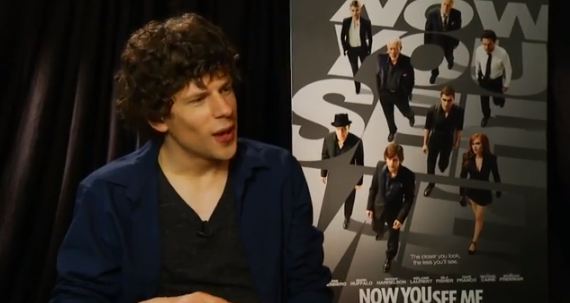
NOW YOU SEE ME Review: Summit Scummit Bites the Dust

Interview With Romina HERE
We know this is a very important interview because at the bottom left of the video a pop up keeps advertising something even after you click it off. Over and over and over again all the way through the interview. So we know there is nothing important being said as it's all about selling something. How do I know this? I guess I am just brilliant. Attribute it to my genius.

Now You See Me
Domestic Total as of Jun. 4, 2013:$35,835,258
Distributor:Lionsgate/SummitRelease Date:May 31, 2013
Genre: ThrillerRuntime: 1 hrs. 56 min.
MPAA Rating: PG-13Production Budget: $75 million


Domestic: $35,835,258   91.8%
+ Foreign: $3,200,000   8.2%

= Worldwide: $39,035,258 HA HA HA LOL!
Domestic Summary
Opening Weekend: $29,350,389
(#2 rank, 2,925 theaters, $10,034 average)
% of Total Gross: 81.9%
> View All Weekends
Widest Release: 2,925 theaters
In Release: 5 days / 0.7 weeks
Louis Leterrier's directing experience


We have here some marvelous actors, and outstanding performances by them. 

And you can bet this was not such an outstanding movie that the actors waived their regular fees for the privilege of performing in it. The director they got because Leterrier knew how to do CGI and action. Boring boring boring. I hope the actors took them for a ride to the bank.
The Players

When you see this movie Summit is credited and Lionsgate is listed below with 
A Lionsgate Company  
So Summit takes the fall for this mess.


But a mish mash of a screenplay and a heisting of as much as possible from The Hunger Games, another one with a fake box that I can't remember and other cliches with great CGI that should have been used for Twilight, New Moon and Eclipse, etc which were milked to give them money to spend and blow. Summit will throw away everything Pattinson and Stewart made for them.

Thursday, May 23, 2013

Review: THE RELUCTANT FUNDAMENTALIST - Reading Through Baudrillard

A Fine Movie

Production Credits

Company Information

  • IFC Films - Domestic Theatrical Distributor
  • IFC Films - Domestic Distribution Rights
  • K5 Media Group - Worldwide Distribution Sales

For a review and comments more traditional please go to the New York Times Link then come back for a post modern reading of it through Baudrillard.

Jean Baudrillard's thinking clarifies this movie. He writes of The Order of Production and the Symbolic Order of the Sacred. We see Changez alternating between the two orders.

To simplify this thinking there is a scene when Erica invites Changez to the opening of her art show. The art is similar to the art below: 


Erica's words in light are about Changez, their relationship, her love for him. Art is in the Order of Seduction, the Sacred. But modern contemporary art has become something different. It has become a production standing firm in the Order of Production. So Erica has "produced" art about something sacred to Changez, his love for her. He is furious that she has commercialized their love. She cannot even understand what she has done in terms of his world. He rages at her, she weeps bitterly that he doesn't understand the "gift" she has made of turning their love into art. He cannot believe she would do such a thing as to cheapen it. 

Two worlds, two different ways of perceiving. The difference between the "US as a business" (Killing Them Softly quote) and the Eastern world of the sacred separate from the secular. Changez has accepted the American dream because colonized countries have been permeated with the American Dream and have no dream of their own. This is what he is beginning to understand. 

And this understanding converts him from a genius financier to a revolutionary Islamist, a non-violent one as he returns to Pakistan to teach at the University and influence younger students in a different world from the American secular success story. One not ready made, but one that must be created, imagined and forged in Pakistan. One that is not completely secular. One that holds sacred values important. 

Saturday, May 18, 2013

Review: THE GREAT GATSBY - So Excessive It Is OBSCENE

All Gatsby did, he did for love of Daisy
 It was built by Mughal emperor Shah Jahan in memory of his third wife,Mumtaz Mahal. 
THE TAJ MAHAL
Two men ruled by obsessive love of a woman

All just for Daisy
Alan Smithee's tweets from Cannes on Gatsby
Recent first:
God help you if you use narration in your work my friends! God Help You! - Robert Mckee in Adaptation

But this isn't his fault. This is the price that an actor has to pay if he is degraded to a marionette of/for an narrator.

from 'nice moment' to 'nice moment' because the characters have nothing more to offer except their appearance. --- That, however

As Walter Benjamin quotes Pirandello in his well known essay Art In The Age Of Mechanical Reproduction: The actor used as prop, the face used as pornographic prop as Baudrillard argues.

But that can't disguise the fact that we need more to fill a film with emotion and content. From the very beginning we got butt kicked...

Leonardo DiCaprio is brilliant. No question. His detached acting in pink linen is exceptional and worth watching the film.

Hollywood is no longer capable of to draw on over 100 years of film dramaturgy in order to tell a story with the easiest, most formal means.

that today's recipient's aren't capable any more to get the clue if he had used the original music --- and keeps us all for complete idiots!

smoking factory and the black men shoveling the dirt of New York, degenerate into pure maculature.

'The Great Gatsby' is an impressive movie but it miss the subtlety of the literary text.

Unfortunately, the bombast of knitting technology destroys the intimacy and prevents it really crackles between the actors.

pounding hip-hop beats. The Idea is: Kick the recipient by force into the Roaring Twenties of Jazz and Green Screen atmospheric set ups.

The story threatens to be buried, especially in the first half of the film under the gadgetry, fast cuts, tracking shots,

You are sucked in like in a black hole and your common sense experiences Spaghettification.

Steven Soderbergh mentioned (mutatis mutandis) he his tired of Hollywood's Mega-Budget-Madness. He will do TV and Twitter Novellas!

schizophrenic camera that buries Fitzgerald's fragile prose under thick layers of equipment, Haute Couture

The first half hour of ‘The Great Gatsby’ is a overproduced, to fancy to be authentic extravaganza nightmare of ecstasy of a detached,

self-promotion. Cannes knows how to party. As Fitzgerald said, A ‘magnificent mirage’. Fitzgerald wrote his novel years before the stock

Besides the cast of ‘The Great Gatsby’ I saw also audience and people on the streets dressed up in ‘Roaring Twenties’ style in shameless

Interestingly enough, the Grand Opening of the Festival with ‘The Great Gatsby’ was more or less a reflection of the film itself.

And in this last comment we have it. The excessive frenzy, particularly of the opening sequences is even more excessive than the excessiveness it is presenting. So excessive it is, as Herzog, Nietzsche and Baudrilard would argue, OBSCENE. And mirrored by the excessiveness of Cannes.

Gatsby is a film composed of floating signs circulating referring only to other signs. A simulation empty of meaning, only speculation is possible.A simulation of the Roaring Twenties, which were themselves a simulation. A film that is a simulation of a simulation, a SIMULACRUM with its own uncanny meaning.

Darren Mooney's Review HERE: At them0vieblog.com

Thursday, May 16, 2013

THE HOST REVIEW: Reading Through the Paintings of Mark Tansey


OK I'll try Albert


Bob7 commenting on a review of The Host HERE:  http://www.hitfix.com/motion-captured/review-andrew-niccol-hammers-another-nail-in-his-own-careers-coffin-with-witless-the-host


Maybe Niccols hates systems. Truman Show deplores reality TV. I haven't seen his other movies, but maybe he's protesting bad cultural and political behemoths. Maybe's he's warning society what will happen if these systems rule our lives and thought, just like Truman Show way before reality TV became prevalent, explored its popularity and its effects. Just saying.
March 28, 2013 at 7:29PM EST Reply to Comment

THE HOST is more and more disturbing the more you think about it. Every scene is framed as a cliche. The screenplay presumably approved by Meyer is composed of ready-mades. There is not one original sentence in it. Each gesture is preprogrammed.The editing is unsurprising, the plot the same.

Mel - a - nee/ Steph - a - nee  Do you believe this Lacanian reading?

What is surprising is that there is nothing surprising in the entire movie, except the ubiquity of cliches as "floating signs", but I can't figure out why they are there.  The seduction between Melanie and Jared is produced, which means there is no perception of seduction. The same is true of Wanderer - Wanda - with  Ian. Both have a playing/kissing scene in the rain. There is a dance scene outside with Melanie and Jared jitterbugging. Wanda in the caves takes a bath and she raises her hands in a sensuous move, or it is supposed to be sensuous. Are you getting the boredom just reading this. Stephenie Meyer's standard GAZE with strange contact lenses, the incest between species, is all predictable from Twilight. 

The music is syrupy romantic 1950's slow dance music. Telling us how romantic the scene is to be experienced. You listen in astonishment not quite able to believe you are hearing this.

Who was responsible for this?

A diversion into Baudrillard:

The Simulacrum According to Deleuze and Guattari


From Copyright no.1, 1987, pp. 90-97.
There is a seductive image of contemporary culture circulating today. Our
world, Jean Baudrillard tells us, has been launched into hyperspace in a kind of
postmodern apocalypse. The airless atmosphere has asphyxiated the referent,
leaving us satellites in aimless orbit around an empty center. We breathe an
ether of floating images that no longer bear a relation to any reality
whatsoever.

1 That, according to Baudrillard, is simulation: the substitution of
signs of the real for the real.

2 In hyperreality, signs no longer represent or refer
to an external model. They stand for nothing but themselves, and refer only to
other signs. 

(As Vija Kinski says to Eric Packer in Cosmopolis, "Money is talking only to itself.") Meaning "money" is only sign now.


So what is going on?

Niccol wrote The Truman Show coming out of the gate long ago. Here's Zizek on The Truman Show:


The ultimate American paranoiac fantasy is that of an individual living in a small idyllic Californian city, a consumerist paradise, who suddenly starts to suspect that the world he lives in is a fake, a spectacle staged to convince him that he lives in a real world, while all people around him are effectively actors and extras in a gigantic show. The most recent example of this is Peter Weir’s The Truman Show (1998), with Jim Carrey playing the small town clerk who gradually discovers the truth that he is the hero of a 24-hours permanent TV show: his hometown is constructed on a gigantic studio set, with cameras following him permanently. Among its predecessors, it is worth mentioning Philip Dick’s Time Out of Joint (1959), in which a hero living a modest daily life in a small idyllic Californian city of the late 50s, gradually discovers that the whole town is a fake staged to keep him satisfied... The underlying experience of Time Out of Joint and of The Truman Show is that the late capitalist consumerist Californian paradise is, in its very hyper-reality, in a way IRREAL, substanceless, deprived of the material inertia.

So it is not only that Hollywood stages a semblance of real life deprived of the weight and inertia of materiality — in the late capitalist consumerist society, “real social life” itself somehow acquires the features of a staged fake, with our neighbors behaving in “real” life as stage actors and extras... Again, the ultimate truth of the capitalist utilitarian de-spiritualized universe is the de-materialization of the “real life” itself, its reversal into a spectral show.


The Aliens have inhabited the bodies of the humans and taken over the planet Earth to save it and us from ourselves. Everything is peaceful and utterly boring, emotionless and cold. It is Simulated Reality. When we go to the caves where the humans are hiding out it is about the same. The young stud types are competitive, the older woman (Francis Fischer) hostile to Wanda and her difference, Uncle Jeb (William Hurt) is predictably protective of her, her little brother Jamie is a typical rather stupid child. The dialogue as boring as in the Simulated sci fi city, the CGI all hard edges and clean, sparkling bright in the city and curved and darkly mysterious in the caves.

(You can read my first reaction to this film that is like everyone else's HERE )

And then it begins to be clear just what Niccol is up to. The humans in the caves are also in Simulated Reality. There is no real. We are in the Matrix. Only the Desert is real so we are reminded of Morpheus's welcome to Keanu, "Welcome to the desert of the real!" Niccol is revealing Simulated Reality to us, our own and our reality to come - all of it simulated.

Every actor is behaving as stage actors and extras.

And then I get it, but only because I heard a presentation on Mark Tansey's work a month ago and was intrigued enough to pursue his paintings further. 
Derrida Queries de Man

MARK TANSEY BY JUDI FREEMAN

What does it mean to make pictures about pictures in 1993? ...When Mark Tansey elected to make pictures about pictures, his was a strategy of confronting the predilection of critics of the late 1970's for minimalism and other forms of abstractions. - Judi Freeman

And BTW reproductions of Tansey's paintings are impossible. Detail is blurred and frustrating. Tansey himself has refused reproductions to become available for authors. It is obvious that he is saying we must see the originals if we want to see them at all.
Which is exactly in line with what his art is saying. He is confronting us with the simulacra that is engulfing us today. When Pap pics of Rob Pattinson walking like a Muybridge motion study and a fan phone camera shot is far more treasured than a gaze at a loved celebrity.

I saw this in Venice in 1972 as I watched the Japanese tourists so busy photographing the city that they never looked at it. Never saw it. I laughed at them. What astonished me then is mainstream today all over.

Andrew Niccol has made a film about films.

Niccol has done with film what Tansey has done with painting.
Niccol has made a film composed entirely of cliches. No fancy costumes to entice us, No cleavage, no faux passion we could mistake for real, music to tell us how to feel that doesn't at all, no real plot twists to surprise us, no face porn to squeeze emotions out of us, no exploitation of the audience to mask the emptiness of mass filmmaking, of film as "empty sign."
ZIZEK
STILL LIFE - MARK TANSEY
Now what can we say about Meyer?

We know she has said in an interiew that she preferred Jacob to Edward. She wants Bella to remain human because if Bella changes, she enters Simulated Reality. 

Is Meyer in on this game strategy? I really can't say, as it is ambiguous to me. Does she or doesn't she know what Niccol did?