Abnegation, if left unchecked,will destroy the faction system.
Jeanine is absolutely correct. Any Divergent can choose Abnegation and hide safely there. Abnegation children raised in Selflessness may choose other factions to experience difference.
But why is she correct?
The Quaker Society of Friends is very close to Abnegation in clothes, demeanor, choice of food, and ideals in their way of life.
It is the Quakers who brought down slavery in the colonies and ultimately the states. They were the first Abolitionists. Beginning in Virginia in 1760. 100 years before the start of the Civil War the stones were laid as foundation to destroy slavery.
The Society of Friends have been active in every anti war movement since they arrived in North America. They were particularly influential during the Viet Nam War and the formal and informal Resistance to it.
Gandhi's non-violent resistance brought down the British Empire's control and occupation of India. His open attack on the caste system stuck a deep wedge in it. Castes were worse than factions as you were born into them and could never leave. Your caste determined your entire life, how much education you would receive, what kind of work you would be allowed to do.
Jeanine Matthews perceives all this as coming from the future and she attempts to forestall it. The divergent population, the transferring to other factions will result in the breaking down of the faction system little by little over time. It is inevitable and Jeanine sees this. She is taking what measures she thinks will avoid it however expertly she implements it, she cannot stop it.
First Scene in Divergent Displaying Acting Credits
This is Lake Michigan in the future all dried up.Rotting, rusty hulks of huge ships are stranded on what was once a mighty lake.
There is no voice over telling us what happened only the beginning music of Philip Glass I think, as the shot goes over the fence and floats towards Chicago's buildings, people walking in their different color faction clothes as Beatrice tells us there has been a war and their city is divided into separate factions.
For anyone who has seen Lake Michigan this is imagining the future time in the novel/movie to us.
But it is also revealing the recent past to us.
THE ARAL SEA
A sea once so huge all of Ireland could have fit into it. A Sea of 1000 islands. Beautiful, rich with fish and sea animals Ruined by USSR dams blocking the water for industrial use.
1000 Islands between New York and Ontario - Resorts and homes for wild animals and people A Comparable body of water.
The ARAL Sea In 44 years less than 10% is left.It is saline.All life is gone or dying
Aral Sea with crumbling buildings looking like Chicago in Divergent
Around the Aral Sea now is a Desert.The camels like it.
See it to the East of the Caspian Sea
Chicago in Divergent Crumbling buildings in disrepair
I would say that this is one of the most profound scenes in any film in decades.Time is twisted so that the future is past and the past is future. Time as a continuum, conceptualized as linear, progressive has been spiraled into a Mobius Strip destroying all conventions of TIME. Reality has been confabulated by the Imaginary. Simulated Reality is Reality and Reality is Simulated. The REAL is coming from the future and the past. This is the message of the book Deep Green Resistance. We are all fixated on our favorite tragedies, fragmented, divided by our emotions, our ideologies, our political beliefs. This is the way they want it so they can continue to plunder the planet until ... !THERE IS NOTHING LEFT!
This is VIOLENCE and it will not be stopped without force.It never has and it never will - Frederick Douglass
Only one time in the movie do we see Four's entire tattoo.
We see it in the scene directly following the one where Four takes Tris into his own Fearscape and Tris sees Four's deepest fear, being beaten with a leather belt and buckle by his father Marcus starting in childhood.
Usually Four stands and calms his breathing and heart rate. (This is standard technique for "flooding" developed by Edna Foa.) Tris however grabs Marcus's belt, punches Marcus and Four protects her from Marcus, thus initiating a new response in Four.
In these two images we have the complete history of Four/Tobias's childhood, in reverse sequence for the viewer.
The Tattoo
The tattoo is a record of his beatings. On a child's skin, a leather belt is going to leave terrible welts, cuts and permanent scars. Not like Patsy's beatings in 12 Years a Slave nor like this slave:
A horrifying explicit vision of Nietzsche's Torturous Inscription of the Body
But you get the idea. To a child it is a terrible thing to endure beatings that leave permanent markings.
Down the center of Four's back on his spinal cord are the five faction symbols.
So with this piece of dialogue we know that every time Tobias displayed curiosity - forbidden in Abnegation - which is linked to intelligence, or bravery, honesty, happiness or kindness Marcus forbid it. And he not only forbid it - the way Beatrice was forbidden - but he was also punished unmercifully for being a curious, kind, intelligent, honest, brave and happy child until he learned never to show any of those feelings. Ever.
The tattoo clearly shows the lash marks probably covering some scars. It clearly shows all five of the factions, desires, attributes, a well rounded person who was emotionally mature might have.
But exposing the tattoo reveals both shame and desire.
In revealing what he has concealed to Tris in his Fearscape and on his back he is confessing shame and opening himself to vulnerability. (Badiou:In Praise of Love)
Tris carefully runs her fingers and hand down Four's back touching him tenderly and admiringly And Four is being touched tenderly for the very first time in his life. He does not wear his tattoo openly nor share it with anyone as he is a very private person. "Not approachable."
This is an explicit Inscription of the Body - Mind always included in this concept - that Nietzsche details for us in The Genealogy of Morals.
Four has turned his torture into body art. He has carved the memory of it onto his back to be there forever.
All you have to do is look at the lashes as they curve around his arms, neck and rib cage, how the belt falls on his shoulder blades and back to understand this. He never wants to forget it. He never wants to forgive. He always wants to remember the terrified child he was.
Is this why he keeps going back into his Fearscape? Has it become erotic for him?
Actually in terms of Behavior Therapy Four chooses flooding - implosion - to confront his fears (Edna Foa). With flooding it is necessary to re-experience the "flooding" on a semi regular basis to keep the fear manageable. It doesn't go away forever.
Spontaneous recovery is a fact of psychological learning theory.
BTW this works really well to desensitize your dog to thunder and Fourth of July explosions. Tape similar sounds, go to confined room with your dog, play the tape very low (read a book or something) until your dog ignores it. Every time you do it increase the noise a little bit. Until you can play it as loud as possible and your dog ignores it. You will have to do it semi regularly to condition your dog as Four is conditioning himself.
Back to Four and Nietzsche and The Inscription of the Body/Mind
Four's body/mind is inscripted by Dauntless when we meet him. He is carefully gendered masculine: he walks forcefully into every scene or exits purposefully. All his movements are deliberate. His dialogue is all truth. No extraneous small talk. He exhibits a frightening awareness of being a killer when he acts in that capacity. He is deadly.
Nietzsche on The Inscription of the Body which also includes the Mind.
192 How does one create a memory for the human animal?
192-193 ....there is perhaps nothing more terrible in man's earliest history than his mnemotechnics. "A thing is branded on the memory to make it stay there; only what goes on hurting will stick"...It is the past - the longest, deepest, hardest of pasts - that seems to surge up....Whenever man has thought it necessary to create a memory for himself, his effort has been attended with torture, blood, sacrifice. ....sacrifice...repulsive mutilations...the cruelest rituals in every religious cult....all these have their origin in that instinct which divined pain to be the the strongest aid to mnemonics.
Nietzsche says more and he says pages about punishment. Festinger's work has showed that the stronger the initiation procedures, the more adherence to the group. Is this the rule for punitive families also?
Engraving your back is not pleasurable. And culturally now, tattooing has become a wide practice. These people are engraving their body/minds. This is a surface Inscription of the Body. Ask anyone who wants to tell you why they have this one, where they got it, how they chose it, what it means, when they got it, who was the artist who did it. Each one is a MEMORY.
Going through a reading of Badiou it is only Love that opens him to vulnerability.
The brilliance of the faction system is its conformity to the faction that removes the threat of anyone exercising their independent will. Divergents threaten that system.
Don't get me wrong. There is a certain beauty to your resistance, its defiance of any categorization.
It's a beauty we can't afford.
Power/Knowledge/Normality
Power and Knowledge are a relation. They form a grid that intersects with history. As capitalism grows the demand for workers/consumers grows and "normality" is demanded. The vagrants, the mad, criminals, derelicts, et al are rounded up and confined all over Europe.
Divergent's Faction System illustrates the Foucauldian Grid. Each faction demands explicit and implicit conformity. Beatrice smothers herself to display the correct behavior demanded of her in the faction of Abnegation. Caleb is able to pass by displaying all the outward behavior of Abnegation as "floating signs" masking the emptiness of his commitment. He passes.
Foucault has taught us that power does not come from above. It seeps from below, through the interstices. Caleb controls Beatrice, inhibiting any spontaneous gesture she begins to make. This is where power is. Right there with Caleb overseeing her every move when he is with her. Pecking at her like a crow, keeping her from growing as a person.
What is important is that Beatrice be obedient. That she display the "floating signs" at least of selflessness.And this is the meaning of the Grid of power/knowledge/normality.
The other aspect here is 24/7 surveillance.
This movie which has so much respect for its fan base signals surveillance without explaining it.
1. Beatrice has been told by Tori to go home, say the test made her sick so she can think over what to do without being in a room with others to distract her. Caleb asks her over dinner prep where she was and she tells him she was sick and came home. He asks her if she finished her test and she says yes. Then he asks her her result. Instead of her usual avoidance or lying, she inverts his question to address his intent by saying, "What were your results?" His questions are interrogative, for the purpose of domination and she turns the tables on him.
2. At the dinner table her father admonishes her for just coming home like that and she says, "I was sick." And still he reprimands her as they are being watched carefully, being scrutinized.
3. When her mother appears as they are loading the truck, right after embracing her Tris says, "Mom, you can't be here." Natalie says, "I know but you're in danger."
So with these few sentences we know people are not only in factions, but they are confined as to where they can and cannot go.So, as in Hunger Games, we get confinement, although not as harsh, but still confinement it is.
Discipline and Punish And here's Taylor Swift
But that's exactly what Foucault meant Swiftie Smart woman
Beatrice gets her hair trimmed the second day of every third month. At that time she may look in the mirror for a minute or so. That's FOUR times a year she gets to see her image in a mirror, from the chest up.
Beatrice at Mirror at Abnegation
Beatrice entering aptitude test room sneaking a look at herself
Tori: What's with Abnegation and mirrors.
Beatrice: We reject vanity.
Tori: Yes, I know. Sit down.
Here's a clip of that scene with commentary by director Neil Burger
So now you have seen that she lies in the chair and looks to her left that is a mirror, seeing herself. She gets up, walks over and sees herself standing for the first time - that is
her entire physical body for the first time, not just from her chest up for a few seconds.
She gestures by raising her right hand as her image mirrors her in the mirror.
Reading through Lacan's Mirror Stage:
This EVENT takes place at six months usually. The mother plays with her baby in front of the mirror as the baby experiences an image that also waves its arms, jiggles its legs, moves in the excitement of its image, before words, before walking, before experiencing any SELF.
Jacques Lacan
Beatrice - and Tobias and Caleb - have never experienced the Mirror Stage in the development of the SELF - the ego.
Beatrice has experienced herself as not selfless enough for Abnegation. She doesn't fit in. She doesn't belong.
How is it possible to feel or be selfless if you don't have a self.
Caleb fakes it by assuming a false self.
Tobias constructs a self at Dauntless.
A ZEN story:
A student goes to the zen master wanting to lose his ego.
"This jubilant assumption of his specular image by the child at theinfansstage, still sunk in his motor incapacity and nursling dependence would seem to exhibit in an exemplary situation the symbolic matrix in which the I is precipitated in a primordial form,beforeit is objectified in the dialectic of identification with the other, andbeforelanguage restores to it, in the universal, its function as subject." (Lacan ECRITS)
Lacan likens theEVENTto Kohler'sAha!of the ape grasping the stick to get the banana, the beginning moment of intelligence.
Beatrice has just experienced herself completely in the mirror then looks to her left, where she is multiplied into infinity.
This is an EVENT!
For Beatrice it has never occurred until the Aptitude Test when she experiences the
EVENT of the Mirror Stage,
which sheds its light on the formation of theI the Imagothat ancient term - as experienced in psychoanalysis. (p.118 Ecrits)
We have only to understand the MIRROR STAGEas an identification, in the full sense that analysis gives to the term:
namely the transformation that takes place in the subject when s/he assumes an image
Turning to the left she sees herself multiplied into infinity and turning around again multiplied.
And there are multitudes of images of Beatrice. To echo the Walt Whitman quote, "I am multitudes." That there is no one person you are. There are changes and they can be made.
Turning around behind her to respond to the command "Choose"
Choose (Now we have had 3 Beatrices)
Beatrice says, "Tell me." She doesn't understand. Choose what as she looks at the luscious raw steak and shiny knife on the pedestal surface. "Choose before it's too late." And then it is too late as the growling ferocious dog comes at her and she looks at the now empty pedestal tables. She has missed her chance by refusing to choose.
But how can one choose between options if there is no SELF to do the choosing? Now she must respond to the simulation - aptitude test - with her instincts, responding to what occurs. Trusting herself to choose now since she is alone with the situation in the simulation. Only now does she experience a self that responds instinctively, rather than complying obediently to demands. As the multiple ferocious dogs get ready to attack multitple Beatrices, Beatrice assumes the position of satyagraha - passivity in the face of violence. At this moment all the multiples disappear and there is just one Beatrice who now responds in multiple ways to the problems in the Simulation. At this moment Beatrice experiences a SELF who chooses, and who chooses instinctively. In a few moments Beatrice has embraced the entire Mirror Stage.
In other words we have TWO egos (at least), if you will. Or rather an unexplainable, pre-linguistic core of a bodily and mental and emotional self that has no words to define it. Just a GESTALT. Identity is irrelevant here. And on this "self" is built the social self, our many identifications, our tweaking of it to present ourselves to our world, our presented and performative self to others. Exiting from the simulation Tori tells her she must trust herself. The test didn't work on her, she is divergent. She leaves the building and on the way home sees some "factionless" outside rummaging through the dumpsters. A woman is there that she looks at. For the first time Beatrice sees the Other as a person, not a nameless outcast. And the factionless woman turns, knowing that she is not only being looked at, but that Beatrice SEES her, and she feels shame, quietly walking away from her gaze. At home she will reflect Caleb's questioning of her result in the test by inverting his question, "What were your results?" And Caleb smiles. Beatrice has felt her SELF and its will to know/power She will continue questioning at the dinner table. The infant repeats the Mirror Stage up until 18 months and then tires of it. The chimp tires of it almost immediately as the mirror is empty. Beatrice repeats it during dinner at home as she turns her spoon over and regards her face in the curved reflection of her spoon. Lacan discusses the non-verbal, pre-verbal imagoas the unalterable core of the self before all social identifications are piled on top of it, obscuring it to our knowing, enabling us to forget it. And this is where Lacan brings in the concept, that again ancient concept, of THE DOUBLE. THE SHADOW. The reflection in the mirror Reading through Baudrillard-LINK Beatrice will encounter her DOUBLE as Tris, when in a life threatening situation, during her fearscape. She is not alienated, as we are, from her DOUBLE, but converses with it as primitive cultures do. This isn't real. Returning to Lacan, the SELF inThe Mirror Stage begins to repeat and to imitate others, building up with social identifications a social or second self. Beatrice after entering Dauntless begins by observing how others are running down the stairs, climbing to the platform, getting on the train, jumping off onto the roof. Copying the others. And then comes the moment, the EVENT for Beatrice. Eric: Who's it gonna be? Beatrice: Me. And Beatrice climbs clumsily up on the ledge, gathers her courage, and she jumps first. Upon landing in the net, Four lifting her out and suggesting a new name, she becomes TRIS She has condensed the Mirror Stage into 2 days. She now begins the journey of building a social self in Dauntless where she will meet her Double a number of times. First in warning in fearscapes, then in joy as she "flies" down the zipline and sees herself reflected in the windows of the buildings,
lastly when expecting to be shot, in acquiescence, at her moment of impending death. The Double appears at the moment of Death. Her Double is silent as she looks at her reflection in a puddle of water as Narcissus did.
We have only to understand the MIRROR STAGEas an identification, in the full sense that psychoanalysis gives to the term:
namely the transformation that takes place in the subject when s/he assumes an image
Shai Woodley and Ansel Elgort from Divergent and Fault In Our Stars
The genealogy of incest is interesting to think about. There was a time of universal copulation among the sexes in groups before any monogamy. The first men who wanted a woman for themselves only, had to buy them from the group, and this was frowned on. Mothers had children by sons, brothers, fathers, cousins, uncles, nephews, and knew nothing about kinship. Certainly those having healthy genes and inbred, survived and flourished, and those having genetic diseases who interbred were ill, died, tended not to have children and pass their defects on. An awareness of filiation evolved to inhibit certain men and women from copulation? Probably. BUT the original prohibition of incest was between brother and sister. Sisters could be traded, sold, given as objects for the purpose of affiliation, with other groups. Underlining the universal fact that marriage is not an alliance between a man and a woman, but an"alliance between two families," "a transaction between men concerning women," Georges Devereux drew the correct conclusion of a basic homosexual motivation of a group character. Through women, men establish their own connections; through the man-woman disjunction, which is always the outcome of filiation, alliance places in connection men from different filiations. .....Male homosexuality is therefore the representation of alliance that represses the ambiguous signs of intense bisexual filiation. .....and men are "never more homosexual than when they arrange marriages." (Deleuze and Guattari Anti-Oedipus :Capitalism and Schizophrenia p. 165)
This is difficult but stay with me:
"Incest is only the retroactive effect of the repressing representation on the repressed representative;
the representation disfigures or displaces this representative against which it is directed;
it projects onto the representative, categories, rendered discernible,
that it has itself established.
In other words incest is now a category, a label, an observed object (Burroughs) that did not exist until it occurred to men to arrange their sisters's marriages with men they had homosexual impulses towards on a displaced filial bisexual phantasy. Now bolstered by the rationalization of alliance and alliance's perks. The present modern "incest between brother and sister," has attracted a feeling of horror, weirdness, illegality, punishment, criminality, and whatever else one wants to attach to it. All it ever was, was projecting backwards onto a practice that allowed men to gratify their homosexual feelings with other men from different filiations. Reading through Foucault the marriage alliances were cemented in time through the glueing together of property.When capitalism intersected, the marriage alliance was strengthened. And the original sexual impulses were buried in the folds of the established ritual. Women had to be pure, so the DNA of their child would inherit the property of their partner's DNA (different filiation). So incest took on a greater taboo between brother and sister. Speculating here on the early exchange of sisters, what if a brother did not want a sister to leave? What if he knew he were sexually attracted to his sister and did not want to share her with another man especially of a different filiation. What if the alliance and her monetary value were of no concern to him? Was that a bad thing? Maybe it was a better outcome for her too than to be "traded" to a strange man from another group? Reading through Cleopatra, who was one of the most intelligent women of her time, speaking all the dialects of the inhabitants of Egypt up and down the Nile, overseeing the export of cotton, planning excellent strategy with Caesar to re-integrate Alexander's kingdom, having a child with him that by all reports was an exceptional adolescent before he was murdered by Augustus (too many Caesars). Cleopatra was the daughter of a father and mother who were brother and sister. Her mother and father were brother and sister of parents who were also brother and sister, (and back for awhile) so proof of insanity, incompetence, inferior intelligence do not hold up unless those attributes are flagrant, and it certainly does not indicate a proof of any horror, criminality, weirdness, etc. I mean does anyone get the woolies because Cleopatra was the child of a sister and brother, who were themselves children of a sister and brother? Who even knew this before a minute ago? All this is in our minds, carefully programmed to think of sex with one's brother as a terrible thing. Well in some cases it probably is. In many cases it would not be consensual. If it happens an abnormal guilt accompanies it. It is the abnormal guilt about it that causes the damage, not the act itself. What is the real danger? Worse even than genetic diseases being doubled and tripled? Other than pregnancy, which is not such a big deal now.
It is that there is no exchange and/or consolidation of property My reading BTW
It flaunts a fuck you in the face of capitalism. So at least if you "succumbed" you must torture yourself all your life about it. Hopefully you will ruin your life over it so as to receive the worse punishment possible on God's green earth that is turning not green.
All this is from Deleuze and Guattari's Anti-Oedipus:Capitalism and Schizophrenia.
I can't stand it another minute. So many tweets on the fact that these two play brother and sister in Divergent and Lovers in The Fault In Our Stars and HOW STRANGE AND WEIRD that is.
Ansel almost didn't get the role because of that. The producers were worried that the fans would be thinking
INCEST! OMG INCEST!
Obviously the ones who keep tweeting and tweeting about this can't tell the difference at some level between reality and a movie. Now if you count the tweets - and they go on day after day - that is a scary thing among girls who are old enough to be online tweeting and writing tweets. What are they thinking, these primitive young women? They are now dragging "incest" a made up idea in the first place, into another level of simulation by imagining two actors in two different movies, being brother and sister and then lovers, and that being weird.
This thinking is the beginning of madness.
THIS KIND OF THINKING IS AT THE ROOT OF VERONICA ROTH'S TRILOGY
- DAMAGED GENES INSTEAD OF INCEST -
BOTH ARE MADE UP
Are you beginning to understand the Muslim world a little better? _________________________________________________________________ And I must add something here about ants. I used to be fascinated with this topic. Some ants in the nest are kept - fed differently like bees? - as royal progeny. In the spring they will be released to fly, mate, and form new colonies. Some related ant colonies are so large they encompass another state or two. But the point I am getting to is that some of these ants commit incest in the nest. These females are kept from flying on the "maiden" journey flyaway. They are forcibly held in the nest to become queens to make more ants. Ant factories I might say.
"Abnegation if left unchecked, will destroy the faction system"
Jeanine is absolutely correct in knowing that Abnegation will eventually ruin the peace based on the faction system as it is, patterned closely on the Quakers and on Gandhi's method of Satyagraha that brought down the United Kingdom, and disrupted the Indian Caste system, where people were born into a caste (determining their entire lives) with never any chance of change. But what did the Quakers do? They began the resistance to slavery in 1760 in Virginia. They were active in the Resistance Movement against the Viet Nam War. Quakers believe in carrying their ideals and beliefs into action. They are not Sunday Christians. The Quakers initiated the abolition movement, destroyed slavery and the wealthy plantation system that depended on enslaved labor. It took about 100 years.The Quakers also fomented the resistance and end to the Viet Nam War. Does anyone think Abnegation cannot do this to the faction system? Abnegation is obstructing Jeanine's plans to introduce materialism and prosperity, i.e. capitalism. They will not be complicit in fostering "capitalism" which will be less regulated, or unregulated by any moral codes of behavior. The movie reveals many things to us without comment. We see some older people in Abnegation as the crowds move in the streets toward the Initiation Ceremony, but few if any in Dauntless. We also see older people in Amity. We slowly learn that the factionless mainly come from failed initiates, especially Dauntless. Dauntless is itself increasing the population of the factionless, increasing the problem of homeless hoards. Dauntless thus creates the factionless that they must protect the city against. Dauntless creates its own reason for being. This information comes to us in a purely visual form with the announcement of being chosen, some information that requires us to connect some dots. It is apparent that at one time Dauntless - and the other factions - were created by some spontaneous and authentic feelings. The factions as we see them 100 years after have become institutionalized. The factions have entered the Order of Production, ensuring irreversibility, metastasizing. What might have transpired is being changed into an Event by Jeanine. This is what Edward Snowden warned about the NSA mass collection of information. He did not say that it was being misused BUT that at any time the administration of NSA changed, with those coming to leadership positions there, this could easily happen. That different people could decide to use the information in a different way that would compromise citizens and reveal their personal lives to their detriment. Divergent gives us this moment in time where institutionalized factions - and we are most familiar with Dauntless - have metastasized into a totalitarian mini state and formed an alliance with Erudite. As Baudrillard tells us through Nietzsche, when the Symbolic Order moves into the Order of Production it becomes IRREVERSIBLE. It metastasizes. This is what we see with Dauntless. New Rules. Roth's book makes this clear in Four's complaining to Tris, but if we can read through Baudrillard we need no explanation as to what's going on here. The Order has changed in Dauntless and in Erudite. Science and technology are on their way to endless complication. The Foucauldian Grid of power/knowledge is now visible. Tris is a true revolutionary. Katniss is a figurehead and those using her are violently fighting the government. So why is Tris this radical figure? An imaginary figure Jeanine has had nightmares about is now present in her reality. Tris is exemplifying Zizek's prescription for breaking the system. One embraces the idealistic pronouncements and works to make them surface, to become reality, to truly be what they are.
Dauntless Manifesto
We believe in ordinary acts of bravery,
And in the courage that drives one person to stand up for another.
Dauntless never give up.
So here we have the ideology. You know like our own freedom, equality and justice for all. Zizek will say to over-identify with the ideology to force it to be what it says it is or disintegrate. Tris has over-identified and continues to push it.
HOW?
First she believes it. (Roth's book pushes this point over and over. To make sure we get it.) The movie shows us Tris's face as Max gives the Manifesto in an address to the new initiates and they are lifted and carried in a ritual of solidarity. An act now empty of meaning but an act of propaganda for the initiates who are seduced. Then she begins to participate in the reality of the training which has little to do with the ideology and a lot to do with obedience and "never giving up."
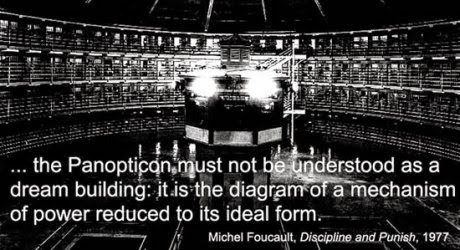
Discipline and Punish - Michel Foucault
Clearly only an Abnegation born and transferring to Dauntless is innocent enough to take this to their hearts. This is why they are a danger to Erudite. Tris believes in the ideology of Dauntless that does not exist in the example of the leaders. Is this familiar to the reader?
This is what forces Tris to expose herself by becoming a PARRHESIASTES. This is the kind of behavior to expect from Abnegation. It is the kind of behavior to expect from the Quaker community, the Society of Friends. It was the kind of behavior that Gandhi displayed to bring down the United Kingdom. "That little man in the loincloth," as Churchill called him. So Jeanine is correct to fear it. Abnegation will eventually ruin her plans, obstruct them for sure.
Jeanine opts for our present government's preference: PRE-EMPTIVE THREAT. That is, like the movie Minority Report, stop the projected violence before it happens, while it is just a small weed to be rooted out, as Mao says of capitalism. This is what our police and law enforcement are doing today. We are under surveillance to make sure we do not plan to do anything in the future that the government might object to.
Jeanine is very modern. She is taking precautions and she is correct in doing so from her perspective.
Beatrice is wrapped in the net as she comes to rest after her jump. She has an expression of happiness on her face for the first time that we see. She has faced a fear of plummeting seven stories down and is in a state of euphoria. This is what we see and what Four sees but we do not see Four seeing; only imagine his seeing. He pulls the net to allow her to sit up and he grabs and lifts her out. Roth's account of this scene is fragmented between the action, what goes through Beatrice's mind about the name change, the dialogue between Lauren and Four and the snippets of conversation between Four and Beatrice/Tris. Beatrice/Tris is the first female Abnegation transfer so she is a surprise. The fact that she is first jumper is also a surprise. The screenwriting team has edited Roth's account. Our first look here at Four reveals his open and rather surprised face. He has witnessed a gift from the sky, from the Heavens miraculously appearing in the net. Like a Silkie from the deep. Four: What,you were pushed?(quietly) Beatrice: No. (all breathlessly happy)Thank you. (as he helps her down) Four: What's your name? Beatrice: B......stuttering Four: Is it a hard one? Beatrice: nodding yes embarrassed Four: You can pick a new one. Make it good. You only get to pick once.(emphasis on choosing with no reversal) Beatrice: stuttering saying Tris. My name is Tris. Four: First jumper - Tris! Welcome to Dauntless. So quick. The contained surprise that the first jumper is a girl, from Abnegation, who appears elated rather than frightened by her ordeal so far. Four is open faced, nice, assertive and non-threatening, non-aggressive. The presentation of the ideal masculine social construction of gender is performed. Four has a beautiful face, intelligent and sensitive and sexy. But he is matter-of-fact all business here, gently and firmly. No provocation, just a short intimate moment. People say that the first minutes of any encounter encompass the whole relationship in miniature. - ALEX by Pierre Lemaitre (p. 339) There is quite a bit of subtext in this short and vivid scene: 1. He underestimates her sort of by alluding to the fact he thinks she was pushed. 2. He offers her a way to change her name with the limiting factor that it is a one shot choice with no return. 3. He intuits her dissatisfaction with Beatrice and suggests it is possible for her to change her name, become a different person, become Other. 4. His welcome is warm and accepting. This is unlike Eric's immediate dislike of her when she volunteers to be first. 5. Through Lacan, Tris rhymes with Chris, short for Christina her first friend. Here is Four's account of that first meeting with Beatrice/Tris in Allegiant: When her body first hit the net, all I registered was a gray blur. I pulled her across it and her hand was small, but warm, and then she stood before me, short and thin and plain and in all ways unremarkable--except that she had jumped first. The Stiff had jumped first. Even I didn't jump first. Her eyes were so stern, so insistent. Beautiful. (Allegiant p. 491) All this in 9 short sentences and the images. Now that is a screenplay folks. Four introduces himself to the group as their instructor and says: My name is Four. Christina: Like the number four. Four: Exactly like the number four. Christina: Were one, two and three taken? Four: What is your name? Christina: Christina. Four: (stepping closer to her face, half smiling) Four: Well Christina, the first lesson you will learn from me, if you want to survive here, keep your mouth shut. Do you understand? Christina: (nodding yes) Four: Good. (stepping back from her) All this is said firmly, assertively, non-threatening in a way that projects that he means what he says. Later at dinner in the cafeteria Tris sits next to him because Christina has maneuvered herself away from him. They are with the transfers from other factions, the ones Four will work with. Tris: Were you a transfer or Dauntless born? Four: Are you kidding?(softly) Tris: No, (smiling and flustered) Four: (coldly) What makes you think you can talk to me? Tris: (abashed now and slightly smiling in embarrassment) Must be because, you're so approachable. Four: (muttering quietly) Careful. His very un-approachableness signals approach, reading through Lacan. "Don't come near me" signals the opposite as a "floating sign" which Tris has accurately picked up. There is more as he takes her through her fear simulations. He is puzzled by how fast she gets through them and her inability to say how she does it so well. After the water drowning sequence: Four: How did you do that? Tris: What? Four: How did you break the glass? Tris: I don't know. I just did it. Four: (sitting down beside her) What were your test results?Your aptitude test. Tris: Abnegation (flustered) Four: (continuing to look at her) I don't think so. Tris: What? Four:I think you're lying to me. Tris: Why would I lie to you? Here is where it gets unusual. He does not accuse her, try to trap her in her lie, argue with her or threaten her. He avoids the Dominating Discourse and does not allow it to frame his thinking or his reply to her. Four: I'm going to ask you one more time. What were your test results? Tris: (still softly) Abnegation. Four gets up, and says, "Time to go." Tris stands up and starts to walk out. (He says what he means and he means what he says.Consistent.) Four: Tris! Just so you know. (as she exits out the door) Dauntless never break the glass like that. Ancient Asian wisdom: To be sincere in the land of the insincere is dangerous. Now we think that he has guessed the truth, that she is Divergent and no one has said a thing out loud. It is a fine, nuanced scene by both actors, subtly performed. A scene for adults I would say or for teens who are observant. The screenplay and the director have a respect for their audience that we don't often see so simply presented.( This is what makes the Divergent screenplay superior to all the others in these YA franchises. The screenplay transcends the plot.Unfortunately this screenplay team will not do Insurgent nor Allegiant nor will Neil Burger be back as director. So do not expect the same quality in the future. Four is still puzzled. The next thing he will do on this subject is to invite her to go through his own fearscape partnering with him. If someone lies to you that means the truth is too dangerous for them to say. They feel threatened by you. They don't trust you. This is the meaning of the lie. This is what Four understands and by taking her into his own fearscape he offers his trust to her as a gift. Tris: In my fear landscape?Four: No in mine. We're going to go in together. Tris: Have you ever done this before? Four: No. Tris: You're going to let me see into your head? (astonished) Four: (nonchalantly)Why wouldn't I? Tris: I don't know. You've never told me anything about yourself and now you're going to just let me in your mind?!!! Four: Are you afraid of that? Tris: Aren't you?!!! Four: No. This is his gift of trust to her. These early scenes establish the character of Four. This is communicated to us linguistically by unambiguous language. Assertive but not aggressive. Not especially emotionally rendered either, very matter of fact, nonchalant. He so far has been consistent. I have left out the exchanges taking place during physical training, but they are factual and low key also. This is a different kind of man and intimate conversation women want but have difficulty engaging in because of the man and their own preconceptions. In this setting we have a master(teacher)/student relationship that is very often emotionally and erotically charged. Reading through Calchi-Novati: LINK Who We Might Be Performing the Potentialities of Otherness and Selfhood: Stephenie Meyer’s Twilight Saga Gabriella Calchi Novati Abstract In Our Vampires, Ourselves, Nina Auerbach argues that vampires ‘can be everything we are, while at the same time, they are fearful reminders of the infinite things we are not’. Disagreeing with her reading, I will show that the Cullen family of vampires in the Twilight Saga tells us not who we are, but rather who we might be. Drawing primarily from the writings ofJacques Lacan and Slavoj Žižek, this paper aims to analyse the performance of otherness and selfhood in the Twilight Saga and the upshot of such a performance. In using this paper by Calchi-Novati in reading the performance of Four in Divergent, is to show a man, not as most men are, but as men might be. Four is a Zizekian "sign from the future" that we must make space for in the words of Calvino: Calvino:“seek and learn to recognize who and what, in the midst of the inferno, are not inferno, then make them endure, give them space.” Of course Roth has begun to castrate Four in Divergent, increased in Insurgent and finishing the job in Allegiant. Roth slops around in the psychological interpretive swamp until there's not much left of him. By the time she has finished Four is diminished and ground down into gray mediocrity. There are so many ways to be brave in this world. Sometimes bravery involves laying down your life for something bigger than yourself, or for someone else. Sometimes it involves giving up everything you have ever known, or everyone you have ever loved, for the sake of something greater. But sometimes it doesn't. Sometimes it is nothing more than gritting your teeth through pain, and the work of everyday, the slow walk toward a better life. That is the sort of bravery I must have now. (Allegiant p. 509) Ugh. And then the Epilogue which is pretty bad also. Hopefully the movie will not follow the book literally. But with Scummit Summit's template of "directors for hire," after the first film, rather than a director like Burger who is an artist, I think we can expect the worst.