Popular Posts

Showing posts with label Nietzsche. Show all posts

Tuesday, July 8, 2014

REVIEW Snowpiercer: A Reading Through Ayn Rand's Atlas Shrugged

In reading this review from Unemployed Negativity more resonances emerged. I love his reading BTW. I am reading the film Snowpiercer through Ayn Rand's Atlas Shrugged, a sort of different reading.
In the early 1960's I attended Objectivist Lectures in Philadelphia given by Barbara Branden. (1960-1962) and sometimes Rand herself came to the Q and A time after the lecture. I never asked one question in two years. I didn't because I had read her fiction and newly published non-fiction (For the New Intellectual and The Objectivist Newsletter) and any question that was asked I already knew what my answer would be and waited to see what Barbara Branden, Nathaniel Branden, Leonard Peikoff, Alan Greenspan, et al and even Ayn Rand herself would reply.The questions were most often stupid and were posed because, well, IDK why........maybe just so they could stand up and ask her a question?
So while Barbara and Nathaniel were cool and poised, Rand would begin to show irritation, frustration (me too) and would sometimes get angry or at least emotional.

Ayn Rand testifying at HUAC-House UnAmerican Activities Committee
In Mason's speech to the people in the "tail" she perseverates by repeating
So be it.
It is so.
over and over again
When Rand was stressed at a Q&A session being the flyswatter that Nietzsche said he wasn't going to be:
("I am not a flyswatter!")
Rand would say with finality:
A Is A!
Inversion of the quote is Nietzschean trope and Rand started with Nietzsche when she was 16 memorizing him

So when Tilda Swinton gives her over the top speech as Mason in Snowpiercer, my immediate association was not Thatcher but Rand in all her outrageousness. Her hair, her facial expressions, all exaggerated of course. Much like the teacher in the classroom car is all Reese Witherspoon in her 1999 movie Election, so much so that I thought young Reese was in the movie for a second.
And less you think these train cars are too too.....
The New Japan Cruise Train
WOW
Another car on Japanese train
Here is a clip of Tilda Swinton as Mason. A man's arm is being attached to a "sleeve" to plug into its gasket in the train to have the arm held out to the way below arctic freezing temperature outside to demonstrate to the "tail" section the danger in revolting and stepping outside the safety of the train. Mason gives her speech and she is quite mad and wonderful.
http://youtu.be/_47ph6EvQPU

Tilda Swinton as Mason in Snowpiercer.

The Sacred Motor is the "sacred" motor Dagny finds at the defunct Twentieth Century Motor Company, where Galt was working and designed it. It is an engine of the future and it is in need of serious repair which Dagny gives to - I forget - to fix. Dagny has plans to put this engine into her locomotives of Taggert Transcontinental. Dagny's engine will ride the rails made of Reardon Metal a metaphorical image irresistible to someone who thinks Lacanian. The engine in Atlas is patterned after Nicola Tesla's engine built for Westinghouse when he was inspiring Edison who stole all his ideas. It was an engine that had no fuel needs, just evidently air, that car accelerated in a few seconds. It was scrapped, its existence hidden, a secret. After all Standard Oil of New Jersey was a powerful corporation at that time. An eternal engine like that would not have been welcomed by the players of the game. Anyway it is gone and we just imagine and guess about it and some try to reinvent it in their garages.

So here it is in all its magic glory in Snowpiercer. A train that circles the earth once each year, like a sort of ground satellite. The Eternal Sacred Engine is everlasting, irreversible, just like Capitalism. It continually goes. The social structure inside the train is confinement of classes. The beggars of the earth are in the "tail" - nice symbolism here - and the Sacred Engine is at the front with its designer who is now getting old. He is wearing out.

The point that Unemployed Negativity brings out is Zizekian thinking. So I urge you to read it. The humans inside the train are confined within the Foucauldian Grid of power/knowledge. Resistance is possible and revolutions do happen but do not overthrow the system. The system devours them like Pac-Man (Marcuse) and is strengthened by them. (Vija Kinski will tell Eric Packer the same thing in DeLillo's Cosmopolis.) Baudrillard will challenge Foucault in his book
telling Foucault to go to the edge of the abyss and continue the pressure until it all implodes into the chasm. Until it commits suicide. 

And this is Snowpiercer, as well as Atlas Shrugged

What Unemployed Negativity says is that no one inside the train can imagine life outside the train in the ice-age out there. And we in our world now cannot imagine our way out of it. Only one person on the train knows about snow. A nice wave to that wonderful novel
Smilla's Sense of Snow
Just in case you never knew this book it is a marvel
The Asian drug addict Kang-ho Song in a wonderful performance has observed that the snow is melting. That they can exist outside the train. 

He wants to create an explosion


that will avalanche the mountains of snow. Curtis now the Curtis Revolution of 18 (years 

they have been on the train) gives in on continuation when Trainbaby shows him what is 

under a hatchlock. He sees what he will have to continue doing and he cannot.

He agrees to the explosion, gives her the match, and these last few 

huddle together waiting for the detonation.

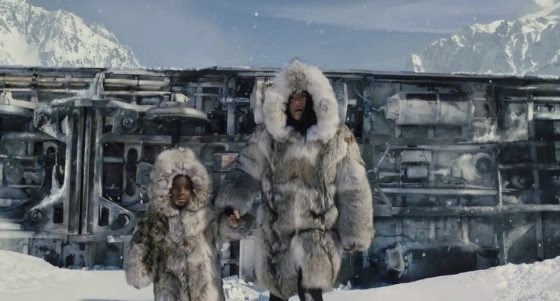
Then when Trainbaby 


Curtis and Trainbaby born on the train 17 years ago

who knows nothing about what is in the world or how people lived, she is the

tabula rasa, she and the rescued child dress warmly and go outside. Her footsteps

 sink but she does not. Nothing is there but mountains of snow until she sees a white 

movement far off.

 It turns and we see a polar bear. Is the bear out hunting for food? She has no weapons,

 no place to go for shelter as the train was burning inside. She and the child are the only 

survivors. That wonderful moment as she pushes her hood off her head bared to the air.


A helpless human. 

A return to the beginning. Eternal Return - Nietzsche

The last frame is the polar bear looking at us.


This is a gorgeous film made by a visionary auteur director Bong Joon-ho


Chris Evans
Tilda Swinton
Jamie Bell
Ed Harris
John Hurt
Alison Pill
Octavia Spencer


Arturo the Polar Bear in Arizona Zoo. - Help Rescue him

Wednesday, July 2, 2014

DIVERGENT Movie: Reading FOUR Through NIETZSCHE


Only one time in the movie do we see Four's entire tattoo.
We see it in the scene directly following the one where Four takes Tris into his own Fearscape and Tris sees Four's deepest fear, being beaten with a leather belt and buckle by his father Marcus starting in childhood.

Usually Four stands and calms his breathing and heart rate. (This is standard technique for "flooding" developed by Edna Foa.) Tris however grabs Marcus's belt, punches Marcus and Four protects her from Marcus, thus initiating a new response in Four.

In these two images we have the complete history of Four/Tobias's childhood, in reverse sequence for the viewer.

The Tattoo

The tattoo is a record of his beatings. On a child's skin, a leather belt is going to leave terrible welts, cuts and permanent scars. Not like Patsy's beatings in 12 Years a Slave nor like this slave:
A horrifying explicit vision of Nietzsche's Torturous Inscription of  the Body
But you get the idea. To a child it is a terrible thing to endure beatings that leave permanent markings. 
Down the center of Four's back on his spinal cord are the five faction symbols. 
So with this piece of dialogue we know that every time Tobias displayed curiosity - forbidden in Abnegation - which is linked to intelligence, or bravery, honesty, happiness or kindness Marcus forbid it. And he not only forbid it - the way Beatrice was forbidden - but he was also punished unmercifully for being a curious, kind, intelligent, honest, brave and happy child until he learned never to show any of those feelings. Ever. 
The tattoo clearly shows the lash marks probably covering some scars. It clearly shows all five of the factions, desires, attributes, a well rounded person who was emotionally mature might have. 

But exposing the tattoo reveals both shame and desire.

In revealing what he has concealed to Tris in his Fearscape and on his back he is confessing shame and opening himself to vulnerability. (Badiou:In Praise of Love)
Tris carefully runs her fingers and hand down Four's back touching him tenderly and admiringly
And Four is being touched tenderly for the very first time in his life. He does not wear his tattoo openly nor share it with anyone as he is a very private person.
"Not approachable."

This is an explicit Inscription of the Body - Mind always included in this concept - that Nietzsche details for us in The Genealogy of Morals. 
Four has turned his torture into body art. He has carved the memory of it onto his back to be there forever. 
All you have to do  is look at the lashes as they curve around his arms, neck and rib cage, how the belt falls on his shoulder blades and back to understand this. He never wants to forget it. He never wants to forgive. He always wants to remember the terrified child he was. 

Is this why he keeps going back into his Fearscape? Has it become erotic for him? 

Actually in terms of Behavior Therapy Four chooses flooding - implosion - to confront his fears (Edna Foa). With flooding it is necessary to re-experience the "flooding" on a semi regular basis to keep the fear manageable. It doesn't go away forever. 
Spontaneous recovery is a fact of psychological learning theory.

BTW this works really well to desensitize your dog to thunder and Fourth of July explosions. Tape similar sounds, go to confined room with your dog, play the tape very low (read a book or something) until your dog ignores it. Every time you do  it increase the noise a little bit. Until you can play it as loud as possible and your dog ignores it. You will have to do it semi regularly to condition your dog as Four is conditioning himself.

Back to Four and Nietzsche and The Inscription of the Body/Mind
Four's body/mind is inscripted by Dauntless when we meet him. He is carefully gendered masculine: he walks forcefully into every scene or exits purposefully. All his movements are deliberate. His dialogue is all truth. No extraneous small talk. He exhibits a frightening awareness of being a killer when he acts in that capacity. He is deadly.
Nietzsche on The Inscription of the Body which also includes the Mind.

192 How does one create a memory for the human animal?
192-193 ....there is perhaps nothing more terrible in man's earliest history than his mnemotechnics. "A thing is branded on the memory to make it stay there; only what goes on  hurting will stick"...It is the past - the longest, deepest, hardest of pasts - that seems to surge up....Whenever man has thought it necessary to create a memory for himself, his effort has been attended with torture, blood, sacrifice. ....sacrifice...repulsive mutilations...the cruelest rituals in every religious cult....all these have their origin in that instinct which divined pain to be the the strongest aid to mnemonics.

Nietzsche says more and he says pages about punishment. Festinger's work has showed that the stronger the initiation procedures, the more adherence to the group. Is this the rule for punitive families also?

Engraving your back is not  pleasurable. And culturally now, tattooing has become a wide practice. These people are engraving their body/minds. This is a surface Inscription of the Body. Ask anyone who wants to tell you why they have this one, where they got it, how they chose it, what it means, when they got it, who was the artist who did it. Each one is a MEMORY.

Going through a reading of Badiou it is only Love that opens him to vulnerability. 

Wednesday, May 7, 2014

Review DIVERGENT: Deconstruction of the Script by Vanessa Taylor

Vanessa Taylor

Evan Daugherty
Disclosure: I was sent a bootlegged copy of Snow White and the Huntsman of Daugherty's sold script and it is so awful I was embarrassed for him to have written it while I was reading it. Even with Hossein Amini's doctoring of it, it was still filled with cringe worthy lines kept from the original. So I attribute the beauty of the writing in the Divergent script to Vanessa Taylor. It is intelligent, brilliantly so. 

As Foucault says, "When the writing is elegant it means that what is said is important."


Universal and Rupert fired him. (A blessing.)Five writers worked on Snow White. Rupert saved that film, made it beautiful. So much for Daugherty.

Aphoristic:Nietzsche's writing is almost completely aphoristic. It is musical and slips through your critical consciousness. The reader has no defenses. Nietzsche the great rhetorician of his time knew this full well. Ayn Rand, his disciple all her life followed his advice. Stephenie Meyer did, aware or not.


Your writing must be even more so than what you are writing about. - Nietzsche

Divergent is pared down, minimalist, no fluff. So is Dauntless.

Beatrice feels everyone is afraid to volunteer to be First Jumper. So she says, "Me."
And this is the pairing of brave/selflessness that Four will say to her later. She chooses here to be selfless which is also to be brave. And she chooses instead of holding back as she has done so far being last down the stairs, up the ladder, on the train, and jumping across the abyss. Now she will be first.

All of this is conveyed in the images and the one word "ME."

Here's Four as we first see and hear him: 


Our first look here at Four reveals his open and rather surprised face. He has witnessed a 

gift from the sky, from the Heavens miraculously appearing in the net. Like a Silkie from 

the deep. Or Dante's Beatrice: a gift from the Heavens, a Blessing.


Four: What,you were pushed?(quietly)

Beatrice: No. (all breathlessly happy)Thank 

you. (as he helps her down)

Four: What's your name?

Beatrice: B......stuttering

Four: Is it a hard one? 

Beatrice: nodding yes embarrassed

Four: You can pick a new one. But make it good. You only get to  pick once.(emphasis on 

choosing with no reversal)

Beatrice: stuttering saying Tris. My name is Tris.

Four: First jumper - Tris! Welcome to Dauntless.

So quick. The contained surprise that the first 

jumper is a girl, from Abnegation, who 

appears elated rather than frightened by her 

ordeal so far. Four is open faced, nice, 

assertive and non-threatening, non-aggressive. 

The ideal  presentation of the Butlerian 

masculine social construction of gender is performed.

Four has a beautiful face, intelligent and sensitive and sexy. But he is matter-of-fact all 

business here, gently and firmly. No provocation, just a short intimate moment.


People say that the first minutes of any encounter encompass the whole relationship in 

miniature. - ALEX by Pierre Lemaitre (p. 339)


There is quite a bit of subtext in this short and vivid scene:

1. He underestimates her sort of by alluding to the fact he thinks she was pushed.

2. He intuits her dissatisfaction with Beatrice and suggests it is possible for her to change 

her name, become a different person, become Other. He offers her a way to change her 

name with the limiting factor that it is a one shot choice with no return.

4. His welcome is warm and accepting. This is unlike Eric's immediate dislike of her (his 

frozen face) when she volunteers to be first.

5. Through Lacan, Tris rhymes with Chris, short for Christina her first friend. 


Here is Four's account of that first meeting with Beatrice/Tris in Allegiant:

When her body first hit the net, all I registered was a gray blur. I pulled her across it 

and her hand was small, but warm, and then she stood before me, short and thin and 

plain and in all ways unremarkable--except that she had jumped first. The Stiff had 

jumped first.

Even I didn't jump first.

Her eyes were so stern, so insistent.

Beautiful. (Allegiant p. 491)
_________________________________________

Here is Tris's account just before she dies.

I choke on a sob as the image of Tobias comes into my mind, of how dark and how still his eyes were, how strong and warm his hand was, when we first stood face to face. (Allegiant p. 475)


____________________________________________

Bataille in his The Eye: Her: Which part of me did you fall in love with first? Him: Your eyes of course.

All this in 9 short sentences and the images. Now that is a screenplay folks. 

Four introduces himself to the group as their instructor and says: My name is Four.

Christina: Like the number four.
Four: Exactly like the number four.
Christina: Were one, two and three taken? 
Four: What is your name?
Christina: Christina.
Four: (stepping closer to her face, half smiling)
Four: Well Christina, the first lesson you will learn from me is to keep your mouth shut,  if you want to survive here. Do you understand?
Christina: (nodding yes) 
Four: Good. (stepping back from her)

I will interject here to make a point Baudrillard makes on seduction and provocation. Christina is provocative not seductive. Tris is seductive.

All this is said firmly, assertively, non-threatening in a way that projects that he means what he says. Four's truth - not his candor - is frightening to Christina, the others and establishes Four's character.The difference between truth and candor (ventilating) is revealed for those who want to make this connection.

The Dauntless training here is immediately demonstrated as serious. We are not going to be your friends. It is not "training lite, decaffeinated training" as Zizek might say. 

Four has been written to be performed as the new masculine. He has established a distance between his students and himself. This intensifies the transference and transgression. And the sexual eroticism.

The trainers have no intention to be buddy buddy friendly with the initiates.And this is 

appropriate in a military paradigm.

In Roth's book his relationship with them is all muddied up. Vanessa Taylor has skimmed off the fluff to reveal the essence. And this is what is contributing to the Desire of the YA female/male viewers.The character Four's Excess is perceived as Desire, reading through Lacan and Zizek. The fantasy always present in Desire evaporates when listening to his interviews. Theo James is not Four. In the case of Twilight and Rob Pattinson it did not vanish but leaked across boundaries of screen and real life.


Neil Burger's direction - in screenplay? - will have Four walk into almost every scene. His is a distinct, purposive, masculine walk that is immediately sexy and seductive rather than provocative.If he is in the scene already his face responds to the context of it.His Inscription of the Body is the new masculine: fit, sexy, sensitive, intelligent, and competent in what he has chosen to do. His flipping with the knives is masculine, the way he stands in the train when he lectures them. All on purpose.

The faces: This is the influence of Passolini on Burger. The use of the face to convey emotion, thinking, hidden feelings, vulnerability, etc. Not the way Francis Lawrence used Rob Pattinson's face as porno in Water For Elephants. This is not to say Four's face is not sexy. It is, but there is more to the image than just beauty. And Burger's use of Tris's face is incredible. That young woman has so many different faces. Her face of repose in Abnegation is completely different from her face in repose in Dauntless. The close close-ups reveal her emotions when she doesn't look pretty or beautiful but very messed up. Shai performs Tris as a girl who grew up never having looked at her face in a mirror. Shai is fearless when looking in the lens of the camera.Rob Pattinson always knows how he looks when he looks in the lens as he was a model. Now he can't unknow it. And then there are those times he doesn't give a shit. 


Primitive cultures felt that mirrors were destructive. One should know their face from the way they respond to people and the way people respond to them. 


Theo James knows and early on in the film - it was shot in sequence - I felt uncomfortableness when the camera closed in on him. Especially when he runs at the head of the initiates and is called over and says, 

"What've you got?" and we are shown the Factionless. It is quick and emphasizes his expressed masculinity - the way Four runs -  as well as showing us the Factionless in a group that appears somewhat menacing. Is it because they were once initiates who were dropped into Factionless status? The question hovers silently.

I am not finished deconstructing this script but this will do for now.

Monday, April 21, 2014

DIVERGENT: Reading Tris as a Nietzschean Revolutionary Through Baudrillard's Forget Foucault


Power/Knowledge are in a Functional Relation Known as the Foucauldian Grid- The Matrix
Power does not come from the top down. It is not something you can have, take, give away, barter, lose, share or anything else of that order. Power comes from below, through the interstices of the Foucauldian Grid. It seeps from below and we see Beatrice caught in that, being denied her "will to know."
Agnes Martin Grid Painting 
Foucault advocates applying resistance pressure locally where it can be most effective. Of course, power does the same.

Jeanine is fusing the power of Dauntless with the Knowledge of Erudite
She is fusing the power/knowledge Foucauldian Grid which will keep the system static
Don't get me wrong. There is a certain beauty in your resistance. But we cannot afford that beauty. Each person in their faction must submit their independent will to their faction, for our peaceful coexistence.

And this is what constrains Beatrice. She rebels in a passive/aggressive way to the pressure of power. Her brother Caleb corrects her, restrains her, introduces her to Jeanine, tells her she is wrong about Abnegation and generally controls her. Her movements are restrained as a child when she wants to run with Dauntless. Her father warns her to be careful at the dinner table. She generally exists in a bourgeois family environment eating dinner together with restrained conversation, preparing meals, dressing so as to limit her freedom of movement. 
She has grown up and lives in the Grid of Abnegation, its Dominating Discourse of language and action.
To jump or not to jump nor reason why


Tris jumps into the abyss
Where there is power, there is resistance. - Foucault
Foucault Straddling the Chasm


Baudrillard has said Foucault does not go far enough. He straddles the abyss. He does not push to excess, extremes to collapse the system. (Following Nietzsche) He does not push to the edge of the abyss and then over.

You must be ready to burn yourself in your own flame: 

how else could you become new, if you had not first 

become ashes? - Thus Spake Zarathustra

This is what Tris does.
Tris is becoming the best Dauntless she can be. 


Tris is exemplifying Zizek's prescription for breaking the system.

 One embraces the 

idealistic pronouncements and works to make them surface, to become reality, to truly 

be what they are. 

She is excessively Dauntless in challenging each event as it escalates.

Dauntless Manifesto

  • We believe in ordinary acts of bravery, 
  • And in the courage that drives one person to stand up for another.
  • Dauntless never give up.
Where Caleb - eating from the trashcan of ideology -  observed the everyday prescriptions of behavior for Abnegation -  which Zizek would label as Abnegation Lite -  Beatrice sullenly complied when she had to. But her will to know was stifled. She could not grow in that environment. She wanted MORE!

Tris is more Dauntless than Dauntless. Worse as Nietzsche says. And in excessively being an excessive Dauntless, Dauntless is imploded and the entire system along with it. 

This is what Edward Snowden has done with his over-identification with the ideology of the United States of America. 
A lot is imploding all around us now.

Now Cody Wilson has come along to take it to excess and implode it.
http://youtu.be/g5fhBBipU3w